Blog
River Bluff Catching: Rebuild Value and Missed Draws
Learn how to reconstruct a river betting range, compare value combos with plausible missed-draw bluffs, and decide whether a bluff catcher can call.
A river bluff catcher calls a range, not a hand name
A bluff catcher loses to every value bet and beats only bluffs. That makes I have a pair and the flush draw missed incomplete reasons to call. First convert the bet size into a required win rate. Then count value combinations supported by the line. Finally, add only the missed draws this opponent can realistically bet. Call only when the bluff share reaches the price you are being offered.
This is not a command to defend a fixed minimum frequency in every game. A missed draw that checks back is not part of the betting range. If combination counting is still unfamiliar, review poker combos and blockers before using this river ledger.
Missed draws do not all become bluffs
The river closes the tree. Draws have completed or failed, and one-pair hands have no future card to improve on. Organize the possible hands into three buckets:
| Bucket | Meaning on the river | How to use it |
|---|---|---|
| Value | Strong hands that expect profit when called | Count only combinations that fit every action and the size |
| Actual bluffs | Low-showdown hands betting to fold out better hands | Count only missed draws the opponent would fire |
| Check-backs | Weak showdown hands or abandoned draws | Exclude them from the betting range |
The common mistake is moving every visible draw into the second row. Some players check back ace-high misses. Some never open the lowest suited connectors. Others abandon weak draws on the turn. A hand can be possible on the board without being possible in this betting line.
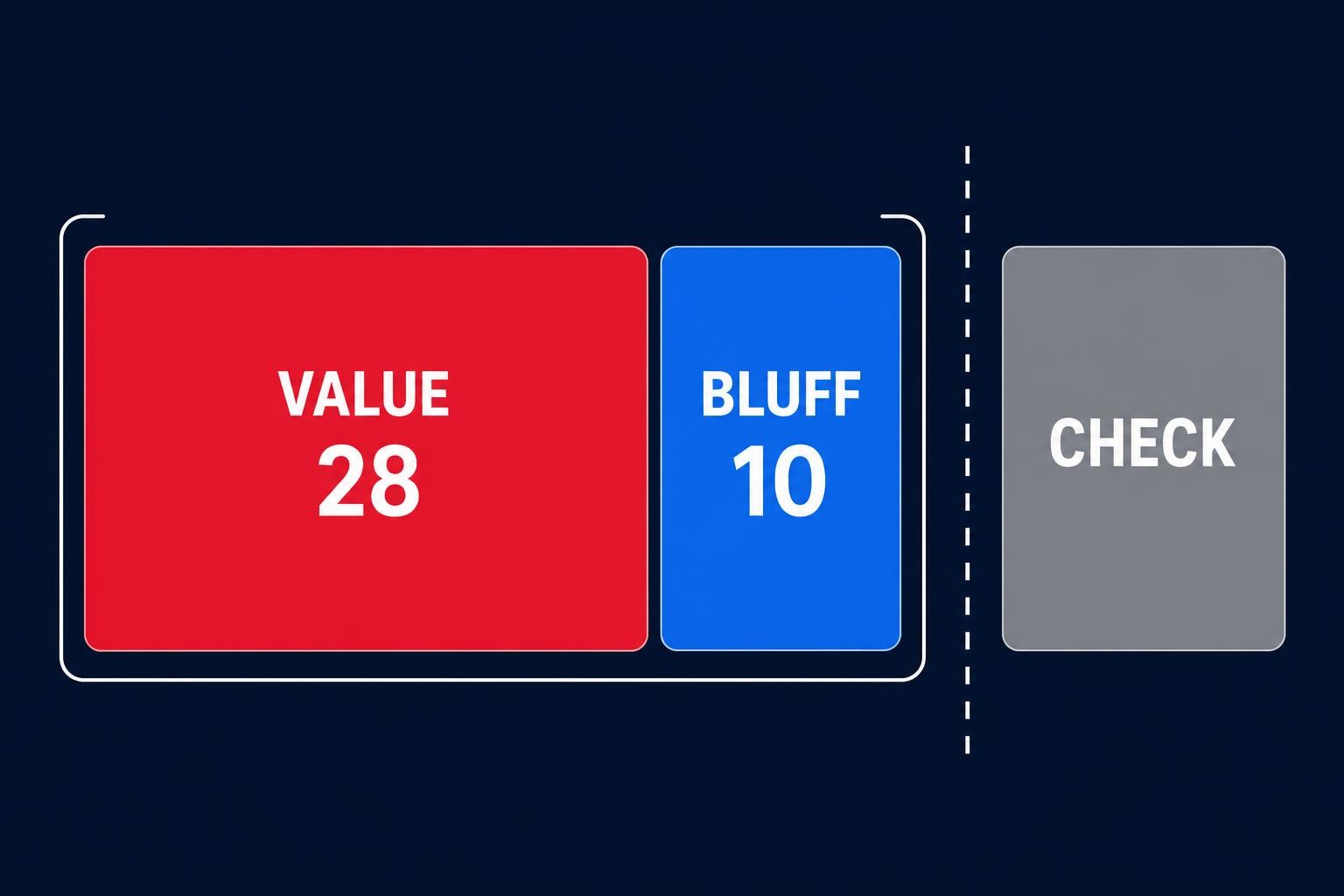
The useful bluff bucket contains only hands that survived the action and still bet; possible but passive misses stay outside the betting range.
Price first, value second, bluffs third
Use the same order every time:
- Price: calculate
call / final pot after calling. - Value: list strong hands that take this line from preflop through the river.
- Bluffs: list failed draws that reach the river and use this size.
- Compare: test whether
bluffs / (value + bluffs)exceeds the required win rate.
If the pot is 27.5bb and Villain bets 27.5bb, you call 27.5bb to contest a final 82.5bb pot. The break-even win rate is 27.5 / 82.5 = 33.3%. At least one-third of the betting range must therefore be bluffs for a zero-rake call to break even. Near the boundary, rake and range-estimation error argue for caution.
Count value first because missed draws are psychologically vivid. When you want to call, it is easy to find one more bluff while compressing sets and two pair into a vague word like strong. Writing value combinations first makes the assumption visible.
Worked hand: a pot-sized bet on the king river
Choose your action before reading the calculation.
Six-max cash, 100bb effective. BTN opens to 2.5bb. BB calls with A♣J♣; SB folds, making the pot 5.5bb.
- Flop
J♦ 8♠ 4♠: BB checks, BTN bets 3bb, BB calls. Pot: 11.5bb. - Turn
2♥: BB checks, BTN bets 8bb, BB calls. Pot: 27.5bb. - River
K♣: BB checks, BTN bets 27.5bb.
A♣J♣ is now second pair. It loses to value but beats failed draws, so it is a bluff catcher. The pot-sized bet requires 33.3% equity.
Make the betting assumption explicit before counting. In this exercise, BTN uses a polarized pot-sized bet with two pair or better for value and checks one-pair hands such as AA, AK, and KQ. This is a practice profile, not a universal claim. In a real hand, discount each entry according to the opening range and street-by-street frequencies.
Twenty-eight value combinations
- Sets: three
KK, oneJJ, three88, three44, and three22= 13 combos - Two pair: six
KJ, twoK8s, twoK4s, oneJ8s, oneJ4s, and three84s= 15 combos
Ten plausible missed-spade bluffs
A♠Q♠,A♠T♠,Q♠T♠,T♠9♠,9♠7♠7♠6♠,6♠5♠,A♠5♠,Q♠9♠,T♠7♠
The names alone are not enough. We are assuming those hands can open preflop, bet the flop, barrel the turn, and fire a pot-sized river bluff. Against a player who checks weak spade draws on the turn or gives up ace-high on the river, reduce the bluff count.
The estimated bluff share is 10 / (28 + 10) = 26.3%. That is below 33.3%, so the baseline decision is fold.
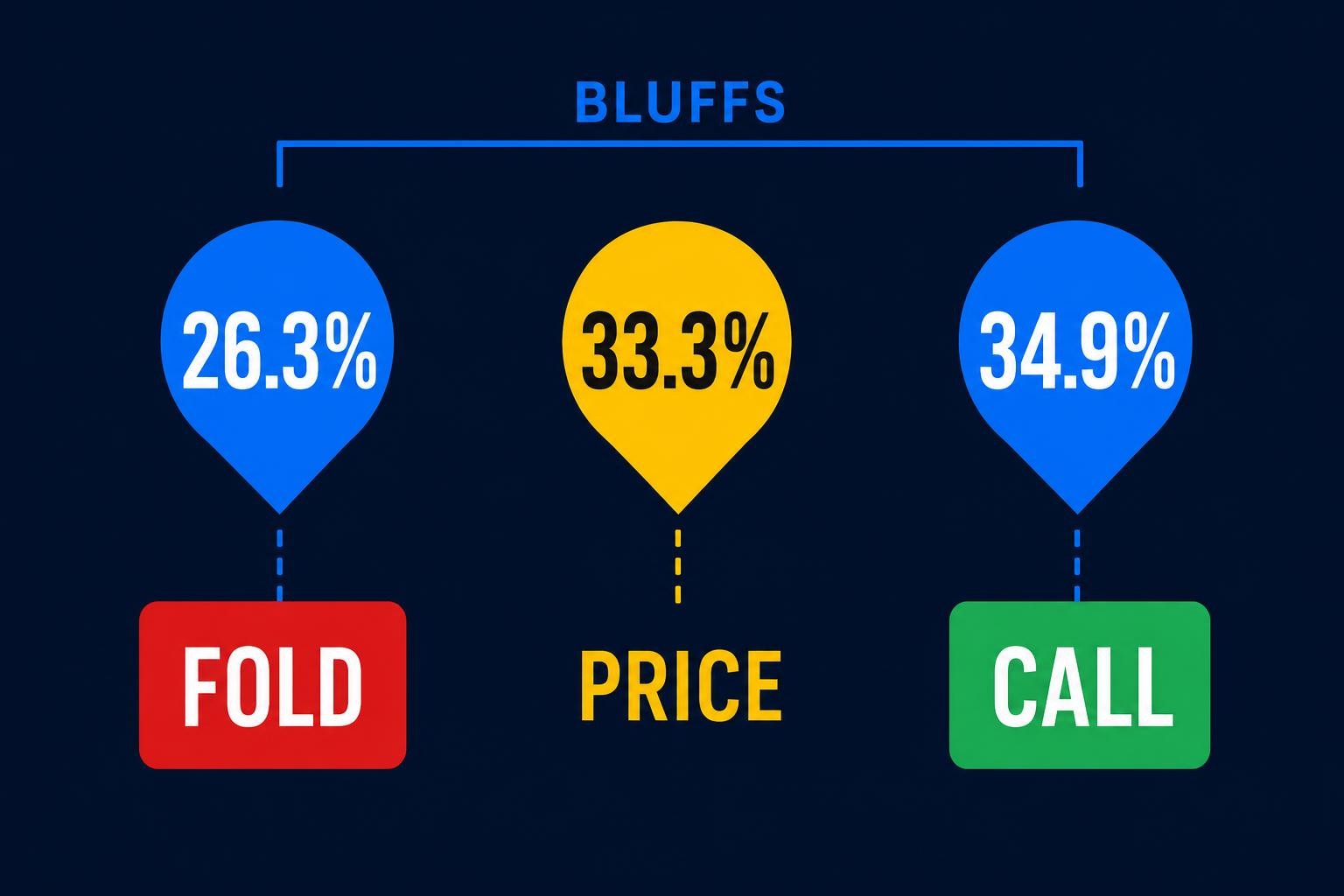
Ten bluffs make up 26.3% of the 38-combo betting range, below the pot-bet threshold even though the board contains obvious missed draws.
The ledger is an estimate, not a claim of perfect information. Its value is that you can inspect and revise every assumption. The draw missed cannot be audited; I count 28 value and 10 betting bluffs can.
Boundary: when the same bluff catcher becomes a call
Now add reliable evidence that this opponent fires nearly every missed spade draw. Add five named combinations to the baseline: A♠9♠, A♠6♠, Q♠6♠, T♠6♠, and 9♠6♠. Value stays at 28 while bluffs rise to 15.
15 / (28 + 15) = 34.9%
That barely clears the 33.3% threshold, so the same A♣J♣ becomes a call candidate before accounting for rake and range-estimation error. The cards did not change; the estimated betting range did. If the opponent instead checks back ace-high misses, the bluff count falls below ten and the fold becomes easier.
Apply blockers to the actual ledger rather than using them as a slogan. J♣ cuts JJ from three otherwise available combinations to one and KJ from nine to six. A♣J♣ blocks none of the named missed-spade bluffs. The A♣ does remove some AA and AK, but this practice profile already checks those one-pair hands, so subtracting them from the 28-combo value bucket would double count the effect. A blocker matters only when you can identify the ledger row it changes.
Write four lines before looking at showdown
For every reviewed river bluff catch, fill in this ledger first:
Bet size and required win rate:
___Line-consistent value combinations:___Bluffs that actually use this size:___Bluff share and decision:___
After showdown, update the estimate without becoming result-oriented. Seeing one bluff does not mean every missed draw belongs in the next betting range; look for repeated lines and sizes. To study the aggressor's side of the river, continue with river value, bluff, and blocker decisions.
Study
Practice river calls in Study
Review river decisions by writing the price, value combinations, and plausible bluff combinations before revealing the result.
Review three bluff catches with one repeatable ledger
Choose three recent river decisions before revealing the results. Write the break-even threshold before reconstructing the range:
| Villain's bet | Required win rate |
|---|---|
| Half pot | 25.0% |
| Pot | 33.3% |
| 1.5× pot | 37.5% |
Use one hand at each size so the changing price becomes automatic. Each time, replace How strong is my hand? with What share of this betting range is bluffing at this price?
Good bluff catching is not the ability to spot a missed draw. It is the habit of putting value and actual bluffs in the same ledger, excluding check-backs, and comparing the remaining range with the price.
Study
Related Study lessons
Related articles
Continue with another angle on the same decision.
One Pair in a Multiway Pot: When to Slow Down
One pair becomes fragile when extra ranges continue. Use players left, bet source, and clean improvement cards to choose between continuing, isolating, and slowing down.
After a Turn Call, Discount Old Value and Add River Value Back
A turn call discounts strong hands already made, but the river can create new straights, sets, and two pair that must return to the range.
How to Choose Bet Sizing When You Are Ahead and When You Are Behind
Bet sizing is not just about whether your hand is strong. It changes depending on whether you want to deny weak equity, charge draws, or push bluff-catchers into folds.