Blog
How to Choose Bet Sizing When You Are Ahead and When You Are Behind
A practical guide to postflop bet sizing through value, protection, and bluffing, with a focus on vulnerable made hands, weak ranges you want to kill, and the sizing that makes bluffs work better.
Bet sizing should be chosen by what you want to keep and what you want to kill
Good sizing is not a display of hand strength. It is a way to make the opponent's continuing range uncomfortable.
Sizing feels difficult in practice not because the percentages are hard, but because the purpose is often blurry. Players remember terms like one-third pot, three-quarters pot, pot, or overbet, yet still feel lost in real hands. The same top pair wants a small size in one node and a larger protection size in another. The same bluff works as a cheap stab in one spot and needs a much larger polar size in another.
That is why sizing should start with three questions:
- Which range do I want to get called by?
- Which range do I want to fold out right now?
- Will future cards make my hand easier to play or harder to play?
Once you think in those terms, sizing stops being a memorization topic and starts becoming a decision tool. This article focuses on three practical areas: how to size when you are ahead and want weak hands to stop realizing cheaply, how to size when you are ahead but vulnerable, and how to size when you are behind and need your bluff to pressure the right bluff-catchers.
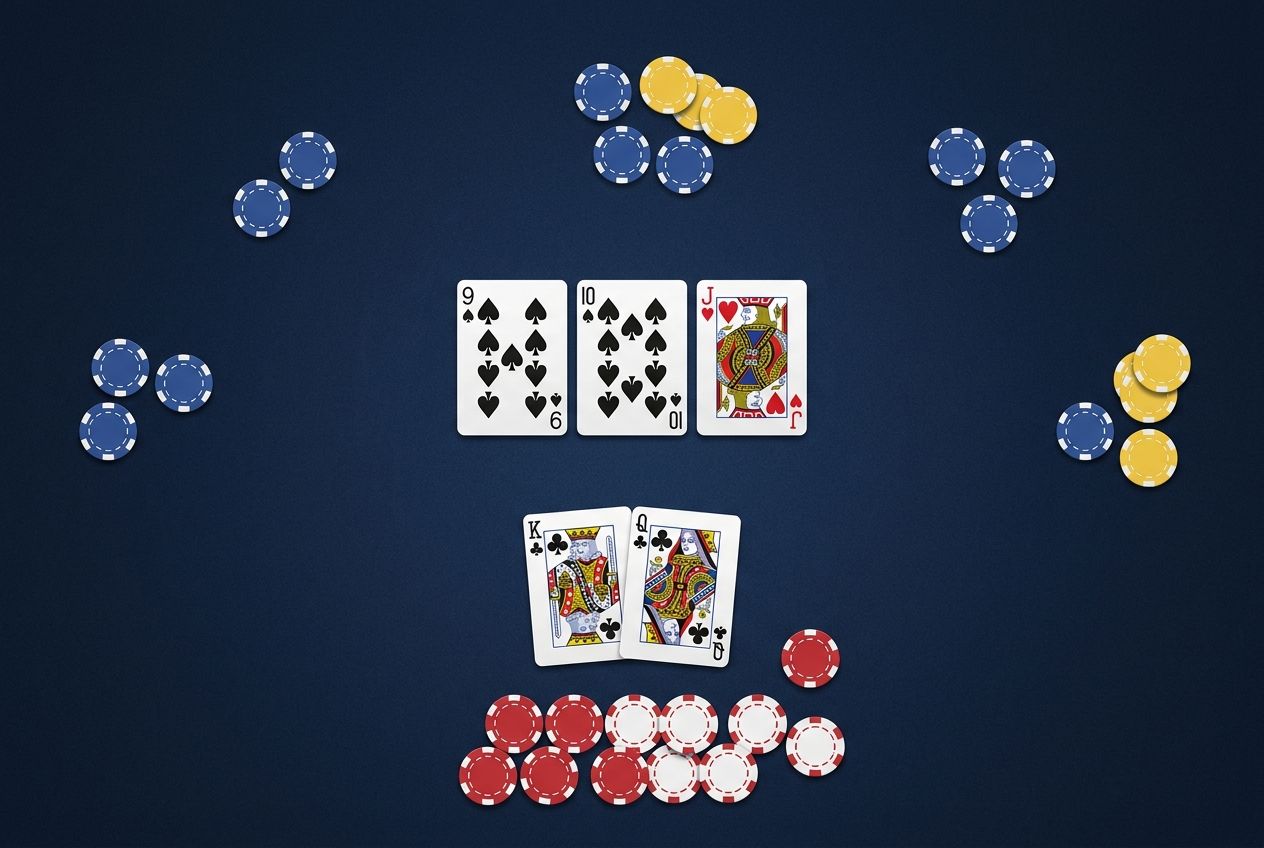
When you are ahead, ask which weaker hands still continue
One of the most common mistakes is thinking in vague shortcuts such as "strong hand, so bet big" or "strong hand, so slow down." Real value sizing is more specific than that.
Take K♣ 8♥ 4♠ when you hold KJ. The key is not merely that you are ahead. The key is that the opponent can still continue with 8x, 4x, pocket pairs, backdoor-heavy A-high, and other weak pieces of the range.
If you bet too small:
- weak overcards see the turn too easily
- pocket pairs continue too comfortably
- backdoors realize too cheaply
If you bet too big:
- weaker
Kxmay disappear - marginal pairs may overfold
- the range you keep becomes stronger than what you actually wanted to target
So the right size is not "big because I am strong." It is large enough to punish cheap realization, but not so large that you lose action from the weaker made hands you wanted to keep.
Killing weak hands really means denying cheap realization
Players often say, "I want to charge the draws." That is true, but the better phrase is broader: you want to deny cheap realization to weak equity in general.
That includes:
- two overcards that should not get a cheap turn
- weak gutshots and backdoors that should not float easily
- low pairs that should not stay in at a very friendly price
- draws that should have to pay more than they want
This becomes especially important when you are ahead but not comfortable. Think of QQ on Q♠ J♠ T♦. It is a very strong hand, but not a calm hand. The opponent can continue with Jx, Tx, flush draws, straight draws, and many pair-plus-draw combinations.
A tiny size in that spot creates two problems at once:
- it keeps worse hands in, but at too cheap a price
- it allows too much realization from dynamic continue hands
That is why a larger size improves naturally there. Not because you are afraid, but because worse hands can still pay and dynamic equity should pay more.
When you are ahead but vulnerable, bigger sizing is often normal value-and-protection poker, not panic poker.
Some winning hands need money now, not later
This is where practical players often get trapped. A hand looks ahead now, so they assume they can bet small, see what happens, and collect more later. But many made hands do not become easier as the hand moves forward.
Common examples are:
- overpairs on wet boards
- top pair good kicker on connected textures
- two pair on boards that can pair, flush, or straighten too easily
Those are not simply "good hands." They are currently winning but structurally vulnerable hands. A blank-looking turn does not always rescue you. It can still leave the opponent with pair-plus-draw, strong draw, and sticky continue regions that keep your later decisions uncomfortable.
That means these hands are often not future value hands. They are present-street value hands. If worse made hands and strong draws will pay now, taking more value now is often better than hoping the next card stays cooperative.
Bigger is not always better for value
Protection matters, but that does not mean bigger is always correct. Thin value is the obvious counterexample.
Suppose you hold KQ on Q-8-4-2-2 by the river. You beat plenty of bluff-catchers, but you are not nutted. The hands you really want action from are often QJ, QT, 8x, and some suspicious bluff-catchers. If you choose a huge size, many of those hands disappear. You end up getting called more often by stronger holdings than by the weaker range you were hoping to target.
That is why small-to-medium sizing fits better there:
- it keeps weaker calling hands in
- your hand is still strong enough to value bet
- you do not need to make your range look highly polar
So again, the question is not "How strong is my hand?" but "Who is actually going to pay?"
Opponent type changes your sizing
One of the more practical ideas that shows up again and again in older strategy material is that sizing should not be chosen from your cards alone. It should also react to how the opponent continues.
For example:
- against players who call too much with weak hands, value sizing can grow
- against hesitant passive players, thin value becomes more attractive
- against players who bluff too often and create their own mistakes, checking medium-strength hands can be better than forcing a thin bet
That last point matters. Many players assume that if they are slightly ahead, they must bet for value. But against very bluff-heavy opponents, allowing them to bluff or overplay after a check can be worth more than placing the money in yourself.
In other words, the best sizing decision is sometimes a good check.
When you are behind, bluff sizing should attack a specific fold layer
Bluff sizing follows the same logic. A weak hand does not automatically want a small bet. The right size depends on the layer of the opponent's range you are trying to move.
Small bluff sizes work best when:
- your range advantage is already clear
- the opponent still has a lot of air or weak equity
- cheap pressure is enough to generate folds
That is why small c-bets work so well on many A-high dry boards. The goal there is not to fold out sturdy one-pair bluff-catchers. The goal is to clear out broadway air, weak backdoors, and low-equity overcard holdings.
Large bluff sizes are different. They matter when the hands you want to fold are not air, but real bluff-catchers like weak king-x, ace-x, queen-x, or medium one-pair hands. In those spots, a tiny bet often gives the opponent too easy a decision. A larger polar size asks a much harsher question.
| What you want to fold out | More natural sizing |
|---|---|
| Air and low equity | Small |
| Weak one-pair bluff-catchers | Big |
| Nodes where your range advantage is very clear | Small |
| River spots where you want to pressure the middle layer | Big / polar |
The point is not "bluffs should be big and value should be small." The point is that the target decides the size.
A checking bluffer is not always a green light for your bluff
Another practical point is easy to miss. When a bluff-heavy opponent checks, many players assume they should stab automatically because the opponent "must be weak." That is not always true. Some bluff-heavy opponents still reach the check with odd bluff-catchers, check-calls, and even surprise check-raises.
So if you hold a fragile showdown hand that is only slightly ahead, betting automatically can be the mistake. In some spots the problem is not that you picked the wrong size. The problem is that betting was worse than checking.
Good sizing starts one step earlier than size selection. It starts with whether you should bet at all.
A practical sizing checklist
Before you bet, run through this sequence:
- Is this thin value, protection-heavy value, or a pure bluff?
- Which weaker hands do I want to keep calling?
- Which hands do I want to fold right now?
- Will future cards make my hand easier or harder to play?
- Is this opponent a loose caller or an overactive bluffer?
- Can a small size accomplish the goal, or does the node need stronger pressure?
That checklist protects you from autopilot. It stops you from betting big just because your hand "looks strong" or bluffing small just because you do not want to risk much.
Memory tip: attach sizes to targets, not to hand names
Numbers get mixed up easily. It is often better to remember sizing by target:
- small: clear out air and weak equity
- medium: keep wider weaker calls in for value
- big: charge draws hard or protect vulnerable value
- very big / polar: attack the opponent's middle bluff-catching layer
That turns sizing into a question sheet rather than a chart. Instead of asking, "How strong am I?" ask, "Who do I want to keep, and who do I want to kill?"
Study
Practice why sizing changes from spot to spot in Study
Train wet-board protection bets, thin value sizing, and polar bluff sizing through repeated scene-based decisions.
Final summary
Good sizing is not a celebration of hand strength. It is a way to force a specific decision from a specific layer of the opponent's range.
- When you are ahead, size according to how much weaker value remains and how expensive weak realization should become.
- Vulnerable made hands often need bigger sizing now because future cards do not automatically make life easier.
- When you are behind, separate small sizes that clear out air from big sizes that pressure bluff-catchers, and remember that sometimes checking is the better strategic decision.
Study
Related Study lessons
Related articles
Continue with another angle on the same decision.
River Value, Bluff, and Blocker Decisions
River strategy is not about betting big when strong and checking when scared. It is about separating thin value from polar value and choosing bluffs through blocker quality and target ranges.
River Bluff Catching: Rebuild Value and Missed Draws
A missed draw is not automatically a bluff. Price the call, count line-consistent value, and include only missed draws that actually bet.
After a Turn Call, Discount Old Value and Add River Value Back
A turn call discounts strong hands already made, but the river can create new straights, sets, and two pair that must return to the range.