Blog
After a Turn Call, Discount Old Value and Add River Value Back
Practice discounting old top-end hands after a turn call, rebuilding river-created value, and choosing between a bluff, value bet, and check.
A turn call discounts the old top end, but it does not erase new river value
When an opponent only calls the turn, reduce the weight of sets and two pair that were already strong and had clear reasons to raise. Then inspect the river separately. The final card can create new straights, sets, and two pair. The accurate sequence is: discount the old top end on the turn, then add river-created value back.
Calling the range simply “capped” skips that second step and can produce reckless river pressure. “Soft-capped” or “top-end discounted” is the safer description here.
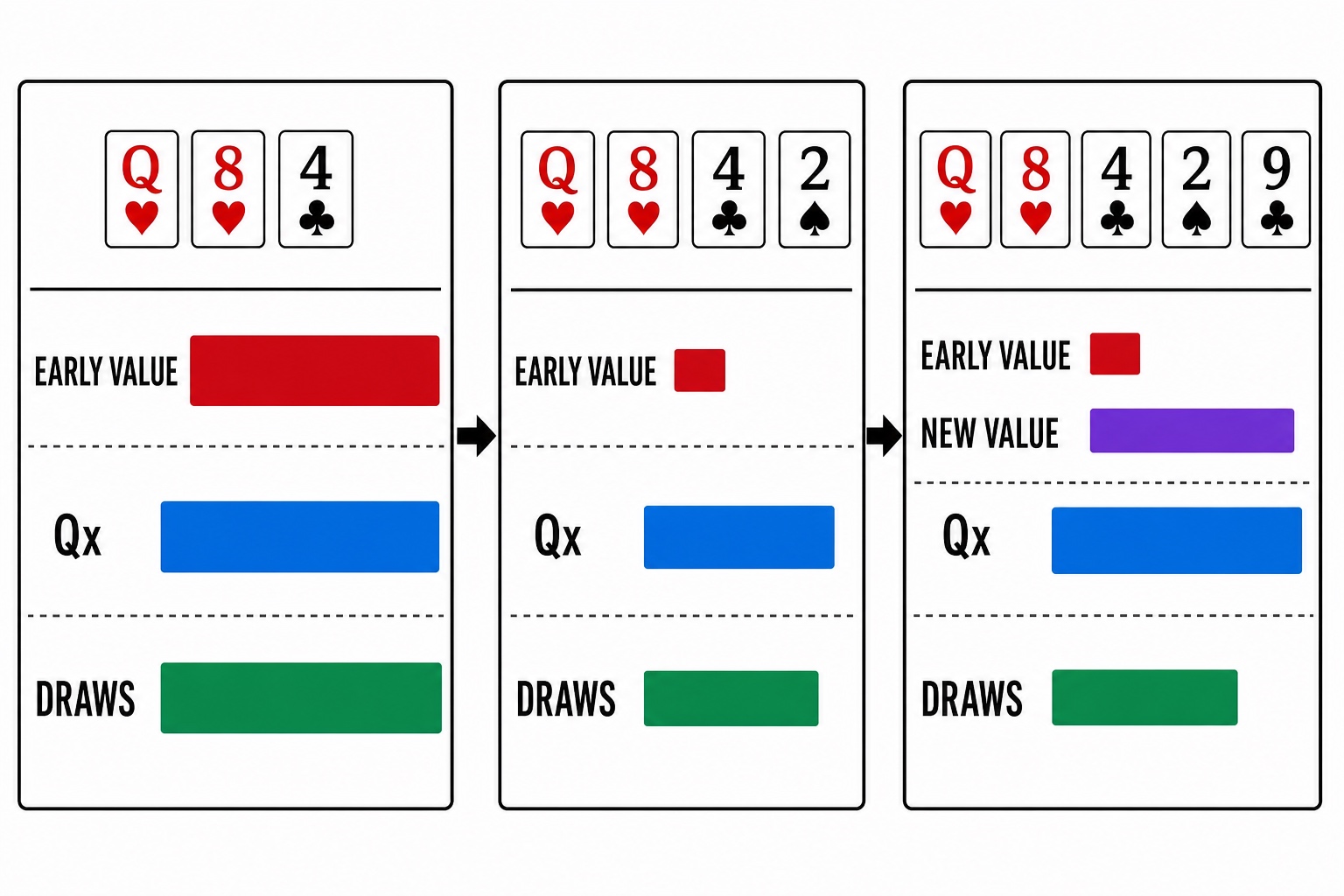
EARLY VALUE loses weight after the turn call. On the 9c river, NEW VALUE appears separately, so rebuild the range with Qx and draws still included.
Read the action line before the scare card—but do not ignore the final card
Hand reading is cumulative. Preflop creates a starting range; flop and turn actions filter its candidates and frequencies. On the river, it is wrong both to add every imaginable hand back from scratch and to freeze the conclusion you reached on the turn.
Hands already strong on the turn often want to raise when:
- draws should be charged,
- the pot needs to grow,
- worse made hands can continue,
- or a river card could kill action.
If those incentives existed and the opponent still called, the old top end loses weight. Next, ask which hands in the calling range the river promoted into new value.
A worked example: CO barrels and BB calls twice
Consider a 6-max cash hand. CO opens to 2.5bb and BB calls.
Flop: Qh 8h 4c Pot: 5.5bb. BB checks, CO bets 3.5bb, BB calls.
Turn: 2s Pot: 12.5bb. BB checks, CO bets 9bb, BB calls.
River: 9c Pot: 30.5bb. BB checks. The hand began about 100bb effective, leaving roughly 85bb behind.
Separate what the turn call discounted from what the river created. Exact combo counts depend on BB's preflop defense and street-by-street frequencies, so attach weights that match the opponent you observed.
| Section | Examples | River treatment |
|---|---|---|
| Strong value already made on turn | 88, 44, Q8s, sometimes 22 | Discount if turn-raise incentives were strong; never delete |
| Value created by the river | JT, 99, Q9s, 98s | Add back because these hands can naturally call turn |
| One pair that remains heavy | AQ, KQ, QJ, QT | Bluff catchers facing a large river bet |
| Draws and weaker pairs | Hearts, T9, 7h6h, 8x, 4x | Some miss, some pair, and each needs a separate fold decision |
The point is not “BB has no set.” It is to reduce the weight of turn-made hands such as 88, 44, and Q8s, while restoring the JT straight, 99 set, and Q9s or 98s two pair created by 9c. This river partially rebuilds the top of the range.
Solve it first: should AhJh make a pot-sized bluff?
You hold AhJh as CO. Write four lines before reading the answer:
- List the old value to discount after the turn call.
- List the value created by
9c. - Name the better hands that fold to a 30.5bb bet.
- Estimate whether those folds exceed 50% of BB's river range.
A 30.5bb bluff into 30.5bb needs 30.5 / (30.5 + 30.5) = 50% folds when showdown value is simplified to zero. Rake and the value of checking back make the real threshold more demanding.
Benchmark answer
- Old value: discount
88,44,Q8s, and some22. - New value: restore
JT,99,Q9s, and98s. - Holding
Jhremoves someJTstraights, which helps the bluff. - Holding
AhandJhalso removes many missed heart draws—the hands most likely to fold. It does not block99,Q9s, or98s.
Without an opponent-specific read, checking back AhJh is the sound baseline. Consider the pot-sized bluff only when your weighted reconstruction shows clearly more than 50% folds from the entire river range. AhJh can also beat some worse missed draws, so its check-back value is not zero.
This complements the river value and blocker guide. That guide starts from the properties of your bluff candidate. This exercise starts one step earlier by rebuilding the opponent's range from the action line and river card.
| River option | Use it when |
|---|---|
| Check back | As with this AhJh, the river restores value and your blockers also remove folds |
| Thin value bet within the range | A separate value hand beats enough weaker Qx calls |
| Polar pressure | The chosen bluff blocks value, leaves folds available, and exceeds its break-even fold target |
The boundary: a soft cap is not a permanent conclusion
Apply a smaller turn discount when:
- The opponent is passive: strong hands are slowplayed often.
- The board is static: few bad rivers make slowplaying cheaper.
- Stack depth is awkward: a turn raise creates an unnatural commitment.
- The river rebuilds the top: as
9cdoes by completing new nuts and two pair here.
Do not translate “the turn call capped the range” into “blast every river.” Use the more accurate rule:
Discount old value by its raise incentive, then add river-created value separately.
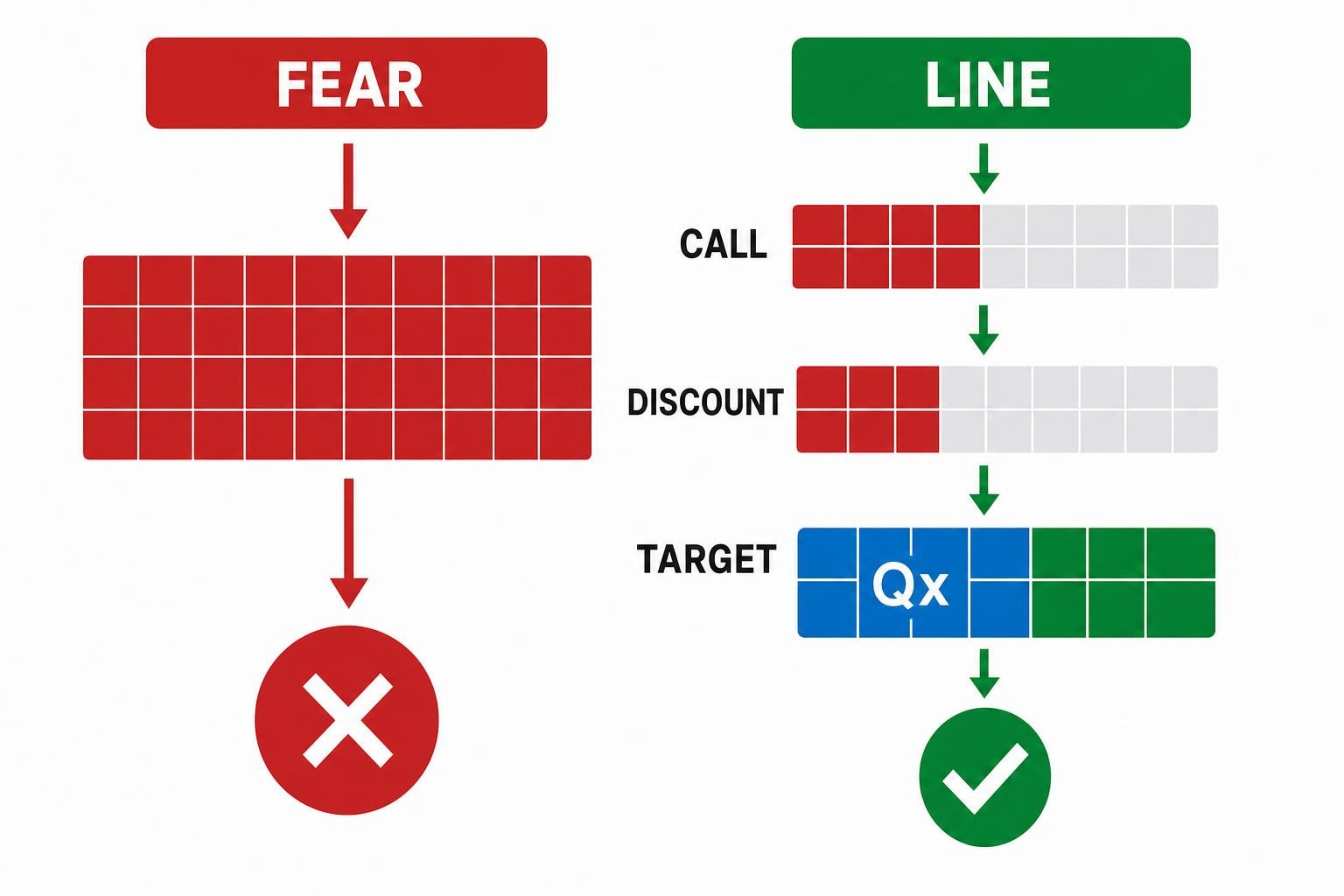
The corrected LINE does not pretend monsters vanish. It applies CALL and raise incentives to DISCOUNT old value, then rechecks the TARGET after accounting for river-created value.
Study
Practice turn-to-river range reconstruction in Study
Train old-value discounts, river-value rebuilding, and break-even calculations before your next river bluff or hero call.
Keep a four-line river review
Which value hands would often raise turn?Which turn calls remain heavy?Which value hands did the river create?Will enough hands fold to beat my size's break-even point?
Transfer the sequence to the next spot. If BTN bets Ks 7s 3d, barrels 2h, and SB calls twice, do not begin with “SB can have everything” or “SB is capped.” Discount the old top end, add the top end created by the last card, and choose a river action that fits both the target and the price.
Study
Related Study lessons
Related articles
Continue with another angle on the same decision.
River Bluff Catching: Rebuild Value and Missed Draws
A missed draw is not automatically a bluff. Price the call, count line-consistent value, and include only missed draws that actually bet.
One Pair in a Multiway Pot: When to Slow Down
One pair becomes fragile when extra ranges continue. Use players left, bet source, and clean improvement cards to choose between continuing, isolating, and slowing down.
How to Choose Bet Sizing When You Are Ahead and When You Are Behind
Bet sizing is not just about whether your hand is strong. It changes depending on whether you want to deny weak equity, charge draws, or push bluff-catchers into folds.