Blog
One Pair in a Multiway Pot: When to Slow Down
Learn a practical multiway-pot checklist for top pair and second pair: count players left, read where pressure comes from, and decide whether your outs are clean.
Diagnose one pair before defending a multiway pot
One pair is not the same hand in a heads-up pot and a multiway pot. When two or more ranges continue, your top pair or second pair should not defend from hand name alone. Use this order: count players still involved, identify where the bet came from, then ask whether your improvement cards are clean. Continue in low-pressure branches, isolate only when the bettor can be wide and the field can fold, and slow down when early strength or several continuing ranges appear.
This article is not a command to fold every one-pair hand. It is a way to stop treating top pair as a complete plan. If you need the earlier step of naming made hands, draws, and air, start with the flop hand-class guide, then come back to this multiway filter.
Why one pair shrinks as more ranges stay in
Heads-up, one pair often has two jobs: it can deny equity from overcards and get called by weaker pairs or draws. Multiway, both jobs become harder.
Three things change at once:
| Input | Heads-up meaning | Multiway adjustment |
|---|---|---|
| Players left | One opponent can have enough misses | More ranges mean more hidden two pair, sets, and strong draws |
| Bet source | A stab can be wide | A bet into several players usually deserves more respect |
| Improvement path | Pairing a kicker may help | Some turn cards improve you while completing someone else's draw |
That is why a one-pair decision should begin before pot odds. If you are not closing the action, a clean-looking price can be fake. A call may invite another raise, or it may leave you guessing on many turn cards.
The three-input ladder for one-pair hands
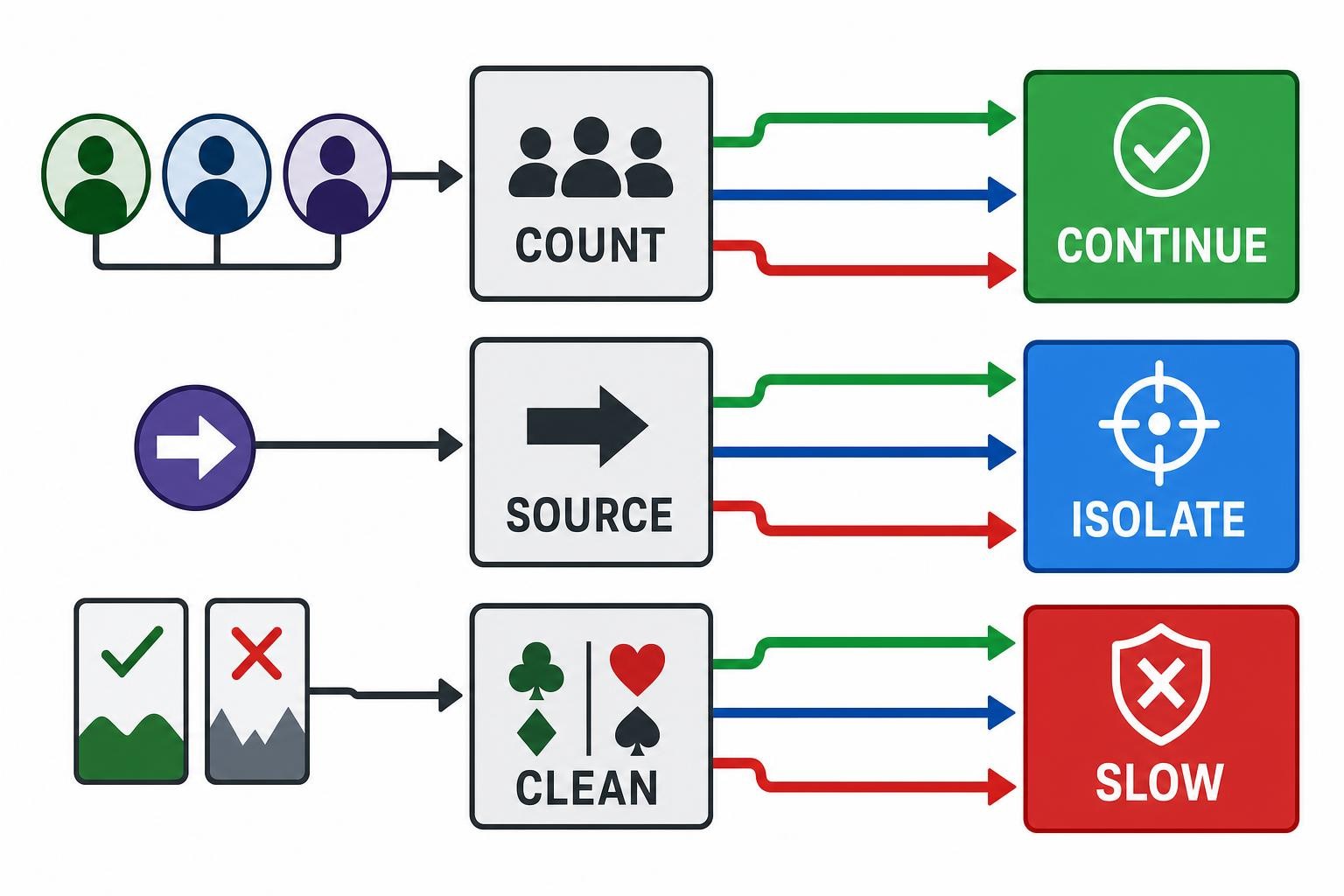
The same one-pair hand moves toward Continue, Isolate, or Slow down as the diagram adds player count, pressure source, and card cleanliness.
In text form, the ladder says: simplify the field first, challenge only a wide source, and downgrade one pair when action stays multiway and the turn deck is dirty.
Use the ladder in this order.
- Players left: Are you heads-up, against one bettor with folded players, or facing action with callers still behind? More players make domination and dirty runouts more important.
- Bet source: A late-position stab after checks can be wide. An early-position bet into the field, or a check-raise after a caller, is more value-heavy until you have evidence otherwise.
- Clean improvement path: When your kicker pairs, it may still lose to two pair, straights, or flushes. A backdoor draw can help only if it does not also complete the obvious front-door draw for someone else.
The branch is not based on courage. It is based on whether your one pair can win unimproved, improve cleanly, or make better hands fold.
Worked hand: top pair faces call plus check-raise
Play the decision before reading the answer.
6-max cash, 100bb effective. CO opens Q♠J♠ to 2.5bb. BTN calls. BB calls. SB folds. The pot is 8bb. The flop is:
Q♦ 8♥ 6♥
BB checks. CO bets 3bb. BTN calls. BB check-raises to 13bb. Action returns to CO.
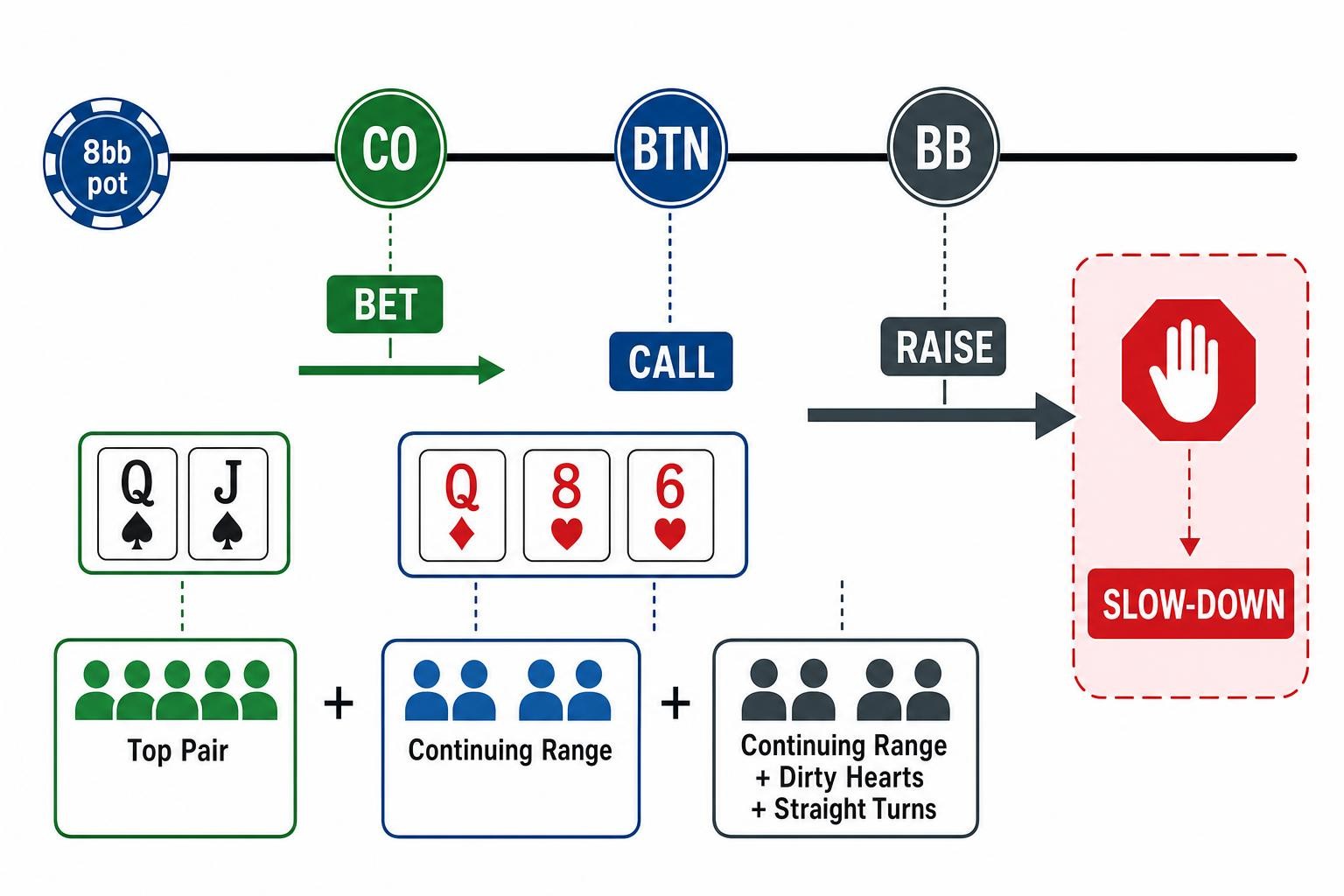
The timeline shows why the hand changes after the call and check-raise: two ranges have continued, and CO is not simply value-betting one opponent anymore.
The action sequence is the point: CO began with value/protection, BTN kept the field alive, and BB's raise turned top pair into a bluff-catcher candidate.
The price looks tempting. CO has already bet 3bb and must call 10bb more. Before CO acts, the pot is 27bb; if CO calls, the pot becomes 37bb, so the direct threshold is about 10 / 37 = 27%. That number is only the floor. BTN has not acted yet, and many turns create difficult decisions.
Run the ladder:
- Players left: Three players reached the flop, and BTN has already called the c-bet. CO is not isolating one loose bettor.
- Bet source: BB check-raised after seeing CO bet and BTN call. Without a read, that line carries more strength than a button stab after checks.
- Clean improvement path: Hearts are uncomfortable,
T,9,7, and5connect many straight textures, and pairing the jack does not guarantee a clean value hand.
The default is to slow down, often folding against unknown opponents. Calling becomes better only with a concrete reason: BB over-raises draws, BTN is capped and passive, stacks make future decisions clear, or CO has stronger equity such as top pair plus a strong draw.
If CO does call, the turn plan must already be narrow. Heart turns and straight-connecting T, 9, 7, or 5 usually face a fold against more pressure. Blank turns can continue only against small sizing or a checked-through line. If BTN back-raises or cold-calls the raise behind, the one-pair plan should collapse without a very specific read.
Boundary: when one pair can still fight back
Change one variable and the answer changes.
Suppose CO checks the same flop, BTN bets 3bb after BB checks, and BB folds. Now CO faces one late-position bet, closes the action for the moment, and can expect BTN to stab some missed ace-highs, gutshots, and heart draws. Q♠J♠ is still not a monster, but calling is much more defensible.
Isolation can also make sense when:
- the bettor is last-position and visibly wide;
- players behind have already shown weakness or folded;
- a raise can fold out hands with equity behind, weak floats, or dominated draws;
- your hand has backup equity, such as top pair plus a strong flush draw.
Do not target better made hands without a strong read and a size plan. One pair is not a license to bluff a protected range.
The boundary is important because multiway is not a magic fold word. The actual warning is multiway pressure that comes from a narrow source while other ranges remain alive.
Turn the spot into a branch label
After the hand, do not write only top pair lost. Write one branch label:
| Branch label | Required evidence | Default action |
|---|---|---|
| Continue | One bettor, weak or wide source, clean turns | Call or small value/protection bet |
| Isolate | Wide stab, foldable field, backup equity | Raise with a plan for turn resistance |
| Slow down | Early strength, call plus raise, dirty runouts | Fold, call rarely, or check future streets |
The label makes the review useful. If you mark ten hands and seven are Slow down, the leak is not bad luck with top pair. It is entering multiway turns with hands that cannot tolerate the next bet.
Study
Practice multiway discipline in Study
Review multiway spots by labeling players left, pressure source, and whether one pair has a clean improvement path.
A three-hand review drill for your next session
Pick the next three multiway flops where you hold exactly one pair. For each hand, fill this out before looking at the result:
Players left:
___. Bet source:late stab / early bet / check-raise / caller pressure. Clean improvement path:yes / partial / no. Branch label:Continue / Isolate / Slow down. My reason in one sentence:___.
Then review whether your action matched the branch. The goal is not to become afraid of one pair. The goal is to stop defending the name of the hand when the action says the pot has changed.
Study
Related Study lessons
Related articles
Continue with another angle on the same decision.
Flop Hand Classes: Made Hands, Draws, and Air
The first real flop skill is not sizing. It is classification. If you can separate made hands, draws, and air, your flop decisions become much clearer.
River Bluff Catching: Rebuild Value and Missed Draws
A missed draw is not automatically a bluff. Price the call, count line-consistent value, and include only missed draws that actually bet.
After a Turn Call, Discount Old Value and Add River Value Back
A turn call discounts strong hands already made, but the river can create new straights, sets, and two pair that must return to the range.