Blog
Poker Tilt Early Warnings: When to Stop a Session
A practical guide to detecting poker tilt through action speed, range narration, sizing logic, table count, and review behavior, then applying process-based session stop rules.
Detect poker tilt in your decision process, not your session balance
You can lose a buy-in while making sound decisions and tilt during a winning session. The useful stop question is not “How much am I down?” but “Can I explain my next decision?”
A rule such as stop at -2 buy-ins looks objective, but it mixes card variance with decision quality. “Stop when I feel angry” is no better: it is vague, and many players notice anger only after their play has already changed.
The default setting here is online cash, where you can sit out every table at any time. Tournament, live, and fast-fold formats have different stopping costs, so a later section adapts the procedure. Keep a bankroll stop-loss as a separate safety boundary. The rule below replaces only the habit of treating profit and loss as proof of decision quality.
The earlier warning is behavioral. Track whether your clicks speed up, whether you choose an action before describing the opponent's range, and whether your size still has a target. The operating rule is simple:
- Continue when the decision process is intact, regardless of the latest result.
- Stop entering new hands when one process signal repeats, then test recovery.
- End the session and tag the hand when a pause does not restore your ability to explain the next decision.
Separate a lost hand from a bad decision first
A river one-outer does not make your earlier decision bad. Winning a large pot does not turn a snap call or purposeless overbet into a good decision either.
Write two different sentences during the session:
- Outcome sentence:
I lost a 100bb pot on the river. - Process sentence:
Before acting, did I name the opponent's range segment I target and its likely response?
The first sentence explains emotional intensity but cannot repair the next action. The second exposes a decision leak. You may still be Green after a painful loss if you can answer the process question. You may be Yellow or Red after winning if you have stopped asking it.
If you want a broader review method for separating result and process, use the money-making versus money-burning spots review alongside this stop rule.
Five behavioral changes create an earlier warning than emotion labels
Do not rely only on “Am I angry?” Compare these five signals with your normal baseline.
| Signal | Normal process | Early warning |
|---|---|---|
| Action speed | Pauses briefly at important nodes | Auto-clicks accelerate after a big pot |
| Range narration | Names the opponent range segments relevant to the action | Chooses from hand strength alone |
| Sizing logic | For value, names worse calls; for a bluff, names better folds | Chooses a size because it “looks strong” |
| Table selection | Keeps the planned count and game | Adds a table or searches higher after a loss |
| Review marking | Tags unclear hands regardless of outcome | Tags only losses or deletes uncomfortable hands |
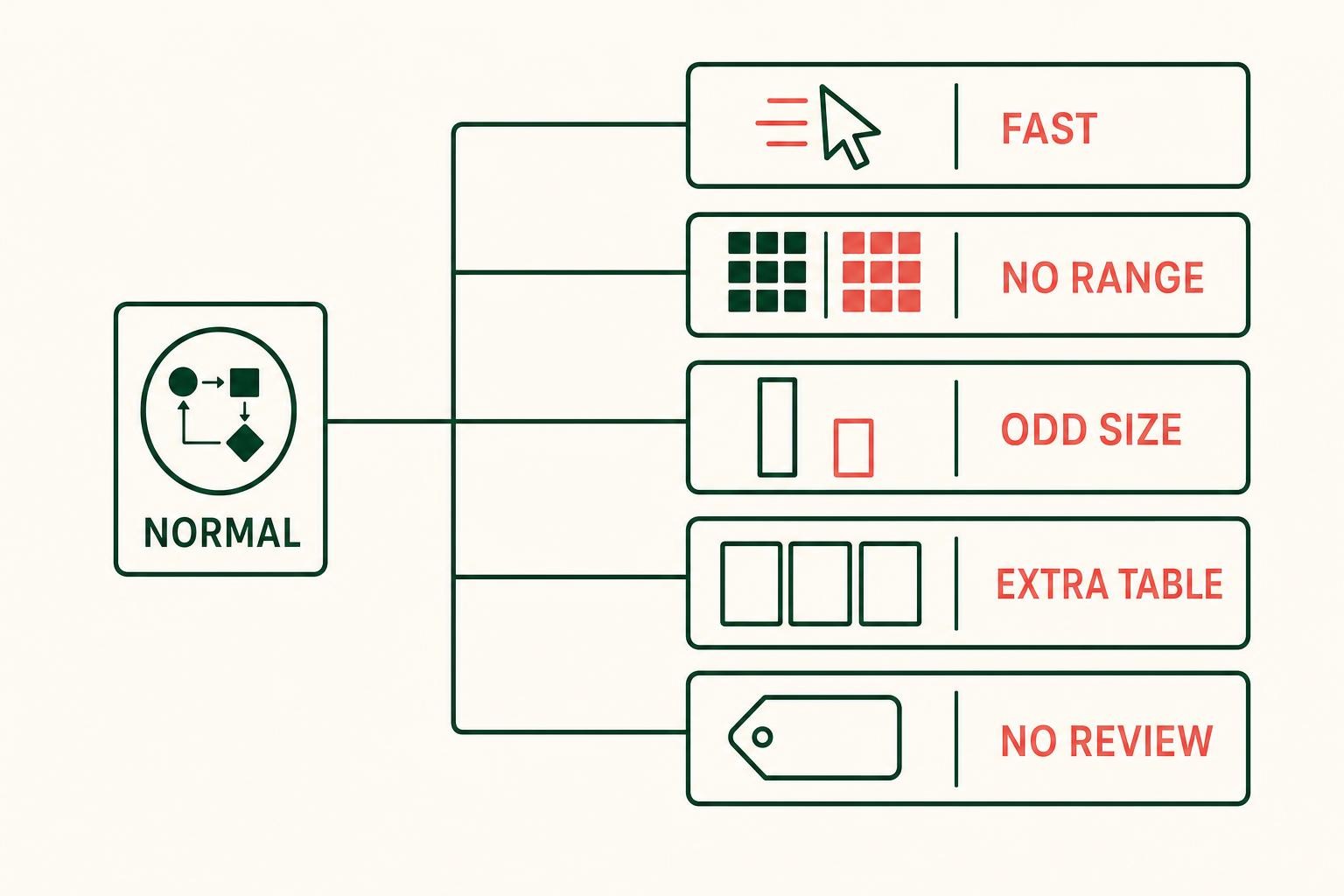
Five branches from one normal baseline show which part of the process deviates before emotion becomes intense.
Cover the labels on the right side of the diagram and use the icons to name the first branch that tends to change in your sessions. That branch is a candidate warning, not a diagnosis. A difficult multiway pot can slow you down; a routine preflop fold can be fast. The useful test is whether a deviation from your baseline repeats and reduces your ability to explain the decision.
Do not guess the repetition count. Record three stable sessions as a starting baseline: which of the five signals appeared, at what pot size and decision, and how often. After each next block of three sessions, review one false alarm that stopped me too often and one miss I noticed too late, then narrow or widen the trigger.
How one river loss changes the next three hands
Consider a 100bb online cash sequence. You open A♣5♣ to 2.5bb on the button and the big blind calls. On K♠ 8♦ 3♣ / 2♣ / Q♥, you bet 33% pot on the flop, 75% on the turn, and 75% on the river. K♦J♦ calls. Whether the river bluff was correct depends on the opponent's range and folding behavior. Losing this hand alone is not tilt.
The process change appears next:
- With
K♠Q♠in the cutoff, you face a button 3-bet and instantly 4-bet without constructing ranges. - You planned to play two tables but open a third.
- In a small river bluff-catch, you stop counting value and bluffs and decide, “I lost the last one, so I call this one.”
The first loss was an outcome. The next three changes are rushed action, an extra table, and skipped range work. Even if the KQs 4-bet succeeds, the warning remains. The mechanism producing the decision has changed.
Trying to recover by playing more aggressively hides the signal behind short-term results. Instead, sit out every cash table before the next blind and explain one of the last three hands without revealing its outcome. If you cannot state positions, effective stacks, opponent value and bluff candidates, and your action's purpose, the missing ingredient is not a better run of cards. It is a pause.
Green, Yellow, and Red describe recoverability—not loss bands
Three states make the next action explicit.
Green: the process remains available
- All five signals remain near your baseline.
- You can describe range and purpose after a large pot.
- You tag uncertain hands instead of hiding them.
Green does not require you to continue. Fatigue, time limits, bankroll rules, and game quality remain valid independent reasons to stop.
Yellow: a warning triggers a no-money recovery test
- A process warning reaches your personal repetition threshold.
- You skip a pre-action question at least once.
- You want to add an unplanned table or move up.
If you do not have baseline data yet, the same signal twice is a conservative starter heuristic—not a universal or validated cutoff. Recalibrate it every three sessions. A signal that immediately increases exposure, such as breaking a stake or table-count rule, moves you to Yellow on its first occurrence.
In Yellow, sit out every cash table. The goal is not to manufacture a calm feeling. It is to test whether decision explanation has returned without risking money.
Red: the process does not recover after the break
- You cannot complete the off-table recovery task, or you miss the process question during controlled re-entry.
- You still want to break table-count or stake rules.
- Avoiding hand tags or winning the money back becomes a reason for action.
In Red, end the session. “I will leave after I get even” reconnects the stop rule to results and therefore cannot be the recovery condition.
Use three questions to continue, pause, or stop
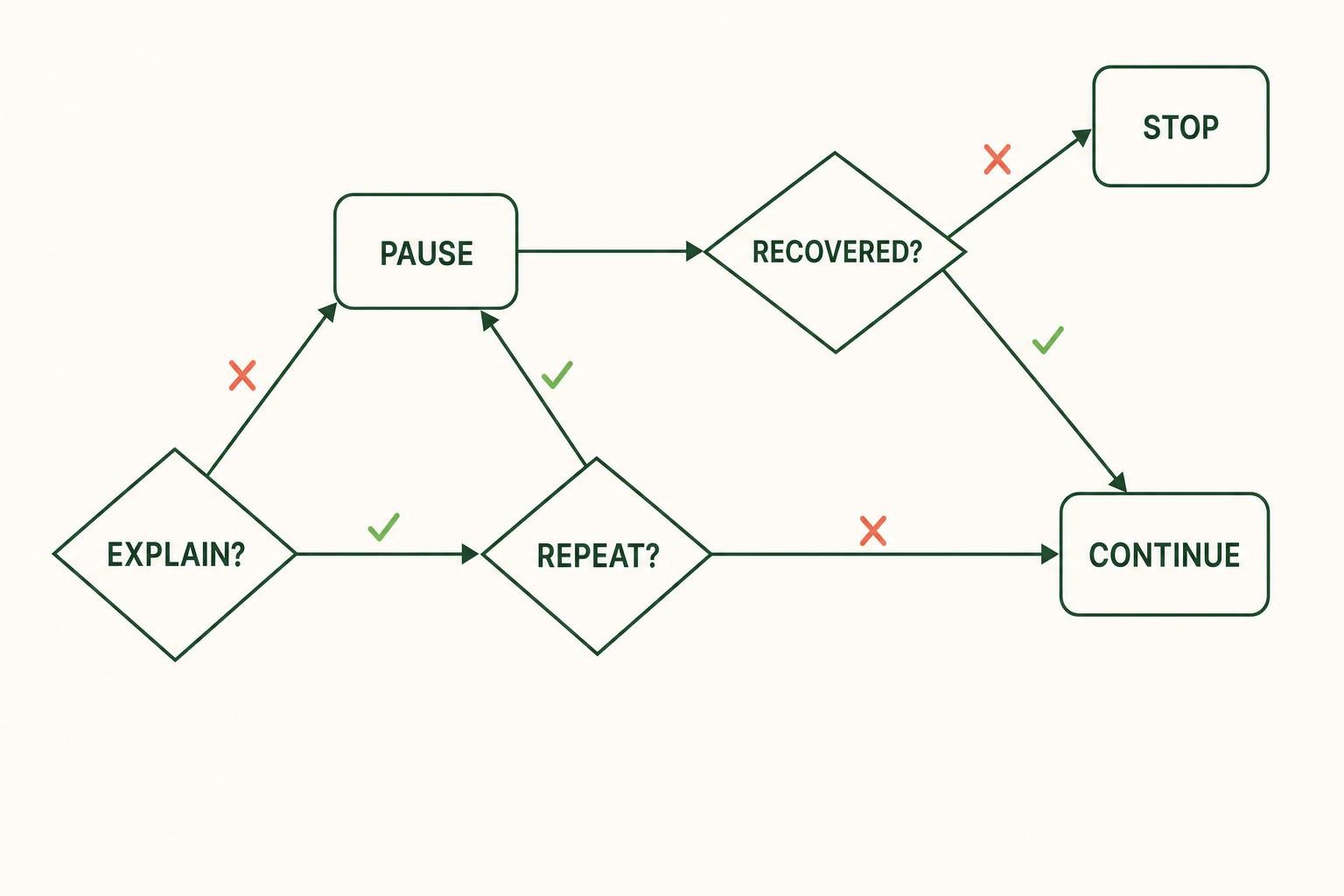
An unexplainable decision or repeated warning converges on Pause; only a no-money recovery pass permits controlled re-entry.
Trace the extra table warning from the worked example through the diagram. It has reached the repetition threshold, so it converges on Pause; it can reach Continue only through the recovery check. Use this procedure:
- Continue only while there is no warning.
If one warning appears but you can explain the last decision and remain below your personal threshold, tag the hand and restore baseline action speed.
- Sit out if explanation fails or the threshold is reached.
Do not deliberately fold for an orbit. Use the platform's sit-out control to remove risk before the next hand.
- Complete an off-table recovery task.
Hide the result of one tagged hand and write positions, effective stack, opponent action, plausible opponent range segments, and the purpose of your action. Restate today's table-count and stake limits. An incomplete field means end the session.
- If it passes, re-enter with reduced exposure.
Open one table at the planned stake. Use a short re-entry window fixed before the session—for a first version, the next two non-trivial decisions can be a starter heuristic. Return to the plan only if every process question passes. One new miss or urge to break a table or stake rule ends the session.
This does not make bankroll limits irrelevant. A maximum-loss boundary can remain a separate safety rule. The point is that I am winning, so my decisions are good and I will stop when I get even are not evidence of decision quality.
Adapt the same principle to the format and the cause
Boundary cases keep the system usable:
- Tournament: do not bleed blinds by sitting out. Stop new registrations, use the time bank at threshold decisions, and run the off-table task at the next scheduled break. Failing it means no new event, not abandoning chips blindly.
- Live cash: leave the seat immediately rather than watching the next hand with chips in play. Complete the recovery task away from the table on paper or in a note.
- Fast-fold: an orbit has no useful meaning. Sit out immediately and restrict any re-entry to one pool and one table.
- Fast action: a routine preflop fold can be quick without being a warning. The same speed in a large 3-bet pot is different.
- Strong emotion: frustration with intact range reasoning is not automatically Red. Calmly moving up to recover losses is an immediate Yellow signal that requires the recovery test.
- Fatigue: explanation can fail without anger. The cause differs, but an unrecovered process produces the same stop decision.
The color is not a judgment about your personality. It is an operating state for the decision system at that moment.
Study
Train your session warnings and stop rules in Study
Practice separating outcomes from decision quality and choosing the next action for each Green, Yellow, or Red state.
Write your first warning and stop condition in one sentence
Fill this in before the session:
My first warning is
________. My current starter threshold is___ occurrences; then I sit out every table. If I cannot explain________without money at risk, I end the session and tag________for review. After three sessions, I adjust the count using false alarms and misses.
For example:
My first warning is faster action after a large pot. My current starter threshold is two occurrences; then I sit out every table. If I cannot name the opponent range segments relevant to the action plus my action's purpose without money at risk, I end the session and tag the hand where the warning first appeared. After three sessions, I adjust the count using false alarms and misses.
A good stop rule does not try to eliminate emotion. It reads the signal earlier, tests whether the decision process can recover, and ends play before unrecovered process damage compounds. The goal is not to become a player who never tilts. It is to become a player who notices the first moment tilt changes a decision.
Study
Related Study lessons
Related articles
Continue with another angle on the same decision.
How to Use a Poker AI Trainer Without Copying Its Answers
Turn poker AI output into a durable study loop by checking inputs, ranges, EV gaps, frequencies, and neighboring spots instead of memorizing one action.
A System That Connects Exploits, Playbooks, and Reviews
Strong players do not just learn isolated ideas. They connect opponent exploits, personal playbook rules, and review outputs into a loop that changes the next session.
Money-Making Spots and Money-Burning Spots in Poker
Poker profit comes less from flashy hero moments and more from stepping into the right recurring structures. This guide breaks down where money tends to pile up and where it most often gets burned.