Blog
How to Use a Poker AI Trainer Without Copying Its Answers
Learn a five-step method for reading poker AI and solver results through assumptions, ranges, EV differences, mixed frequencies, and practical review rules.
Treat poker AI output as a comparison experiment, not an answer key
The easiest way to use a poker AI trainer or solver is to look for the brightest action color. If Bet dominates the cell, bet next time. If Check is larger, remember to check. That feels efficient, but the lesson usually disappears as soon as the stack, range, or available bet sizes change.
A stronger method treats the output as a conditional comparison experiment. Audit the inputs, inspect the whole range before one hand, compare EV gaps as well as frequencies, and then create a rule that survives a nearby board change.
Once you understand the different roles of GTO and exploitation, the next skill is not copying a balanced output. It is understanding the assumptions that made that output reasonable.
Step 1: Audit the input contract before the result
The same hole cards and flop can represent different problems when any of these changes:
- cash game or tournament structure,
- 30bb or 100bb effective stacks,
- BTN versus BB or UTG versus BB,
- single-raised or 3-bet pot,
- the opening and calling ranges,
- rake assumptions,
- and whether the tree allows check, 33%, 75%, or all-in.
This is more than careful setup. The inputs define the boundary of the strategy. A polished 100bb BTN-versus-BB output does not answer a 40bb UTG-versus-BB question.
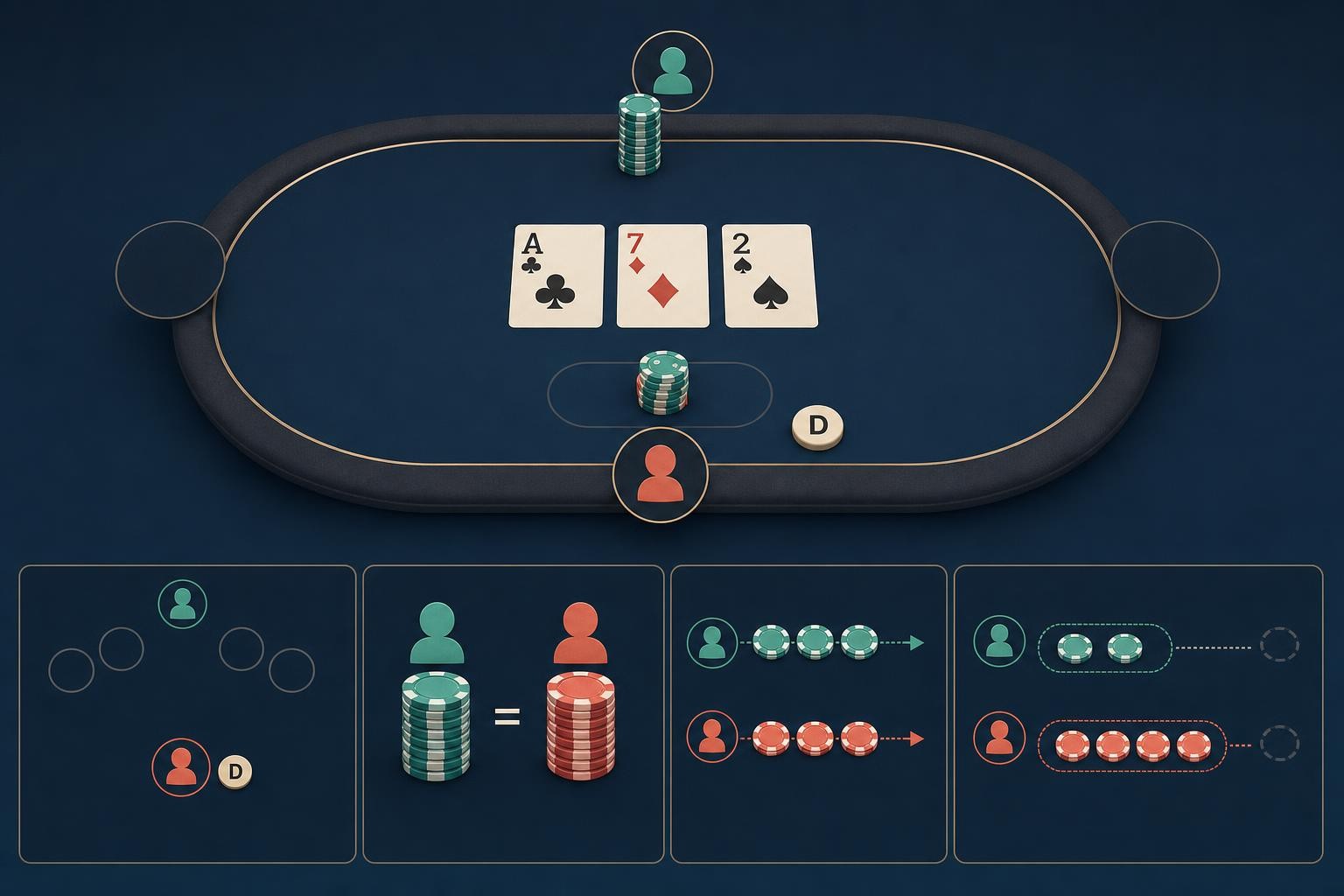
Before reading a result, say the spot in one sentence:
100bb cash, BTN opens to 2.5bb, BB calls, the pot is 5.5bb, the flop is
A♣ 7♦ 2♠, BB checks, and BTN may check, bet 33%, or bet 75%.
If you cannot state that contract clearly, you are not ready to generalize from the output.
Step 2: Read the range map before your hand cell
Now give BTN Q♠J♠. A common habit is to search for that square immediately. Better questions come first:
- How many strong
Ax, overpairs, and sets remain in BTN's range? - Which weak
Ax,7x,2x, and pocket pairs reach the flop for BB? - Which unpaired BTN hands retain backdoor flush or straight possibilities?
- Does the checking range keep enough hands that can improve or bluff-catch later?
The action for Q♠J♠ belongs inside this structure. In isolation it is just queen-high. Inside the range it is a low-showdown-value candidate with backdoor potential. A visually similar Q♥J♥ has a different suit relationship on this board. The useful question is not “what color is this square?” but what job does this combo perform for the range?
Step 3: Read the EV gap, not only the EV winner
The following numbers are an invented study result, not a solved recommendation.
| Action | Frequency | EV |
|---|---|---|
| Check | 52% | 0.84bb |
| Bet 33% pot | 43% | 0.86bb |
| Bet 75% pot | 5% | 0.78bb |
The highest number is 0.86bb for the small bet. Saving “Q♠J♠ bets one-third pot” would still miss the lesson. Check trails by only 0.02bb and both actions carry substantial frequency. The output says two more useful things:
- checking and betting small are close alternatives;
- betting large is comparatively difficult to support under these assumptions.
A tiny EV edge is sensitive to modeling choices. A slightly different calling range, rake model, action tree, or solve precision can reverse the order. When two actions are close, treat them as members of the same strategic family rather than labeling one correct and the other a mistake.
Step 4: Translate frequency into range roles
A mixed frequency is not just an instruction to press a random button 43% of the time. Study why similar combos split.
- A backdoor flush can create more useful turn barrels.
- A particular suit may remove continues or, less helpfully, remove bluffs.
- The checking range needs hands that can improve or absorb later pressure.
- The small-bet range needs air with future playability beside its value hands.
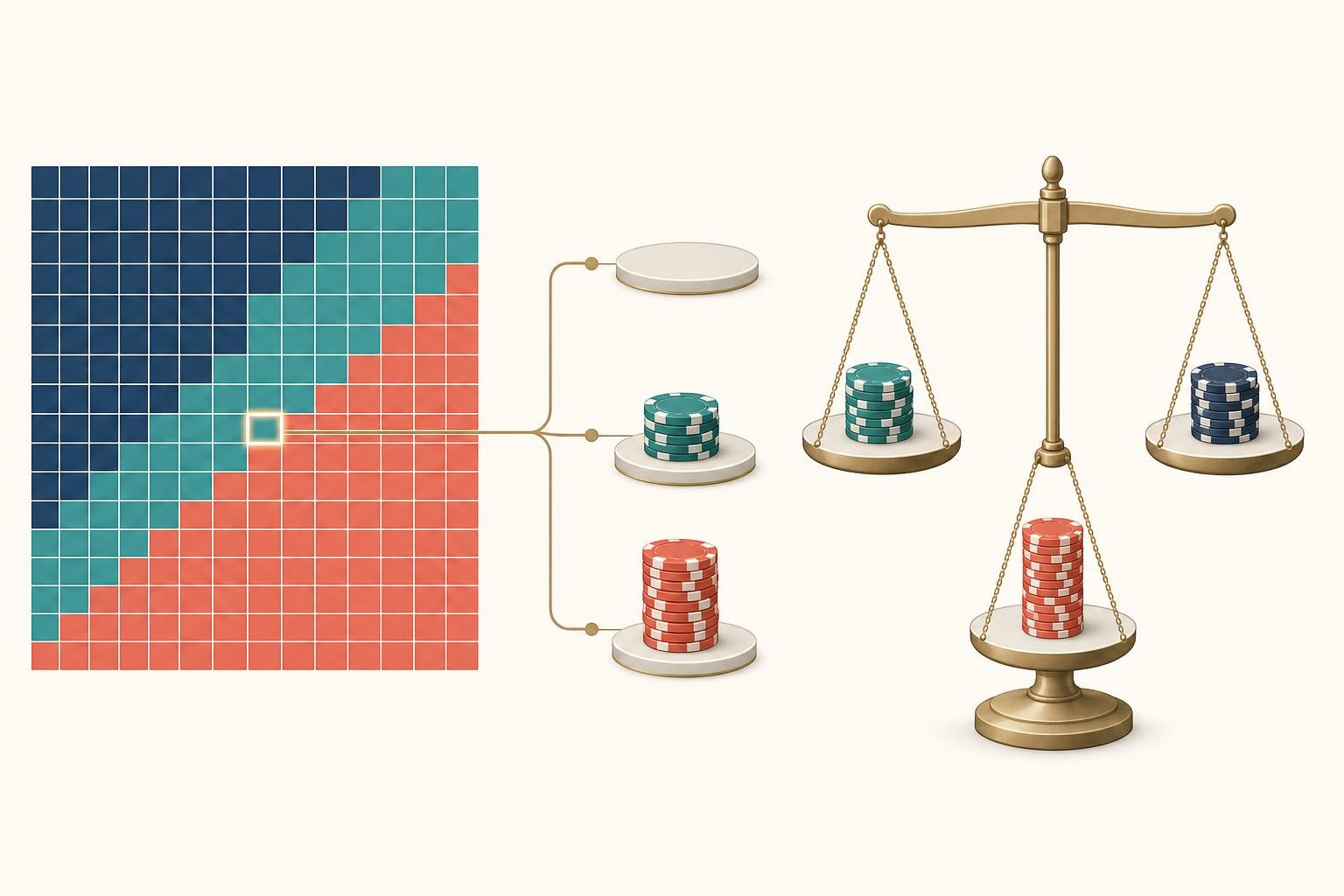
A weak note says, “Bet this hand 43%.” A stronger note keeps the condition and the role:
On dry ace-high flops, low-showdown-value hands can mix small bets and checks; better backdoors move more combos toward betting, while the checking range still needs future defense.
That sentence remains useful after the exact percentage has faded.
Step 5: Stress-test the rule with three neighboring nodes
An explanation built from one board is still a hypothesis. Compare at least three nearby conditions:
- Change the high card: replace
A♣ 7♦ 2♠withK♣ 7♦ 2♠. Which player now owns more of the strongest range? - Change the suit structure: turn the rainbow flop into a two-tone flop. Which backdoors become immediate draws?
- Change stack depth: reduce 100bb to 40bb. How does the connection between a large bet and a later shove change?
If the same reason survives all three tests, the rule is becoming durable. If one small change destroys it, you may have memorized a screenshot rather than learned a strategy.
Habits that make poker AI training misleading
- Looking at your square without checking the input ranges.
- Treating a 0.01bb difference as a major error.
- Keeping only the highest-frequency action from a mixed strategy.
- Repeating a baseline after a real opponent clearly overfolds or overcalls.
- Turning one ace-high flop into a rule for every ace-high board.
The more precise the tool looks, the more carefully you should question it. Numerical precision in the output does not guarantee accuracy in the assumptions.
Study
Turn an analysis result into one usable rule in Study
Rebuild the hand from its preflop structure, ask a precise review question, and finish with a conditional rule you can test in your next session.
A 10-minute loop you can run on one hand today
- Before opening the result, write the positions, stack, pot, action history, board, and available sizes.
- Describe the strong and weak parts of both ranges before locating your hand.
- Compare the top two actions by EV gap, not frequency alone.
- Explain the role your combo plays in each action family.
- Test one board change, one suit change, and one stack change.
- Finish with one conditional rule in the form “when this condition holds, take this action for this reason.”
The goal of poker AI study is not to remember a number in the next hand. It is to build a reasoning sequence that can produce a new answer when the conditions change.
Study
Related Study lessons
Related articles
Continue with another angle on the same decision.
A System That Connects Exploits, Playbooks, and Reviews
Strong players do not just learn isolated ideas. They connect opponent exploits, personal playbook rules, and review outputs into a loop that changes the next session.
Poker Tilt Early Warnings: When to Stop a Session
Tilt often damages the decision process before it feels like anger. Use five observable signals and a Green-Yellow-Red recovery test to choose between continuing, pausing, and ending a session.
Money-Making Spots and Money-Burning Spots in Poker
Poker profit comes less from flashy hero moments and more from stepping into the right recurring structures. This guide breaks down where money tends to pile up and where it most often gets burned.