Blog
GTO vs Exploit for Practical Players
An intermediate practical guide explaining GTO as a baseline, exploit strategy as adjustment, and how over-folding or over-calling opponents change your real-world decisions.
GTO is a baseline, not a religion. Exploit is how you move away from it when the table earns it
Strong practical poker comes from knowing the baseline and knowing when real opponent mistakes justify moving away from it.
Many intermediate players treat GTO and exploit as if they belong to opposite schools of thought. GTO feels cold and mathematical. Exploit feels human, instinctive, and aggressive. A cleaner frame is simpler: GTO is the baseline, exploit is the adjustment.
That means GTO answers the question, "What does a stable, hard-to-punish strategy look like here?" Exploit answers the question, "Where is this opponent or pool deviating enough that I should punish it?"
If you understand that relationship, practical poker gets much simpler.
- You stop treating GTO like a script you must memorize perfectly.
- You stop treating exploit like random aggression.
- You start building a repeatable decision process for real 6-max games.
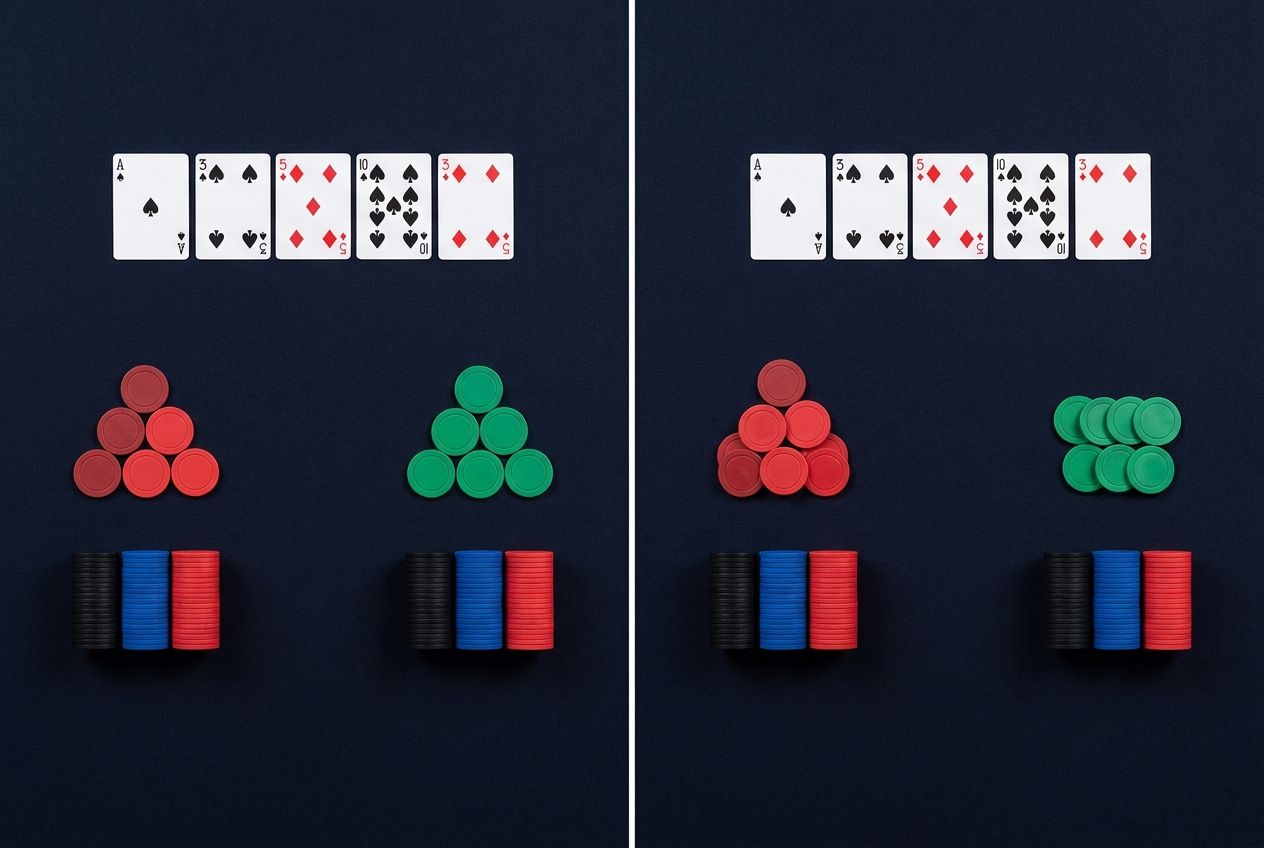
GTO gives you a stable reference point
The biggest beginner misunderstanding is thinking GTO means "the most profitable play in every real game." In truth, GTO is closer to a balanced reference model. It matters because it prevents your strategy from becoming easy to exploit when you do not yet have a strong read.
Its real value is not the exact number printed by a solver. The real value is the logic behind the number.
Why does one board allow small size at high frequency? Why does another board want more checks? Why do some hands bluff better than others?
Those are GTO questions, and their answers create a useful baseline.
Imagine a button open, big blind call, and an A-7-2 rainbow flop. The opener usually holds more strong ace-x and stronger high-card coverage, so a wide small c-bet strategy makes sense. Once you understand why that is true, similar ace-high dry boards become easier to navigate even without memorizing exact frequencies.
Exploit means targeting repeated weaknesses
Exploit becomes powerful when the opponent keeps giving you the same mistake:
- folding too often to flop c-bets,
- failing to defend enough versus turn barrels,
- calling rivers too wide,
- under-bluffing river pressure,
- refusing to 4-bet enough preflop.
Those leaks justify adjustments.
| Opponent tendency | Adjustment from baseline | Practical note |
|---|---|---|
| Over-folds flop | Increase small bluff c-bets | Prefer air with backdoor equity |
| Too passive on turns | Barrel good turn cards more often | Especially on cards that help your range |
| Over-calls river | Thin-value wider, bluff less | Medium-strength value gets better |
| Under-bluffs river | Fold bluff-catchers more often | Do not over-defend just to feel tough |
Notice that good exploit is specific. It says where the leak is, how you change, and which hands or sizes benefit from that change.
Why real-world profit often comes from exploit execution
In real 6-max games you rarely face perfect balance. Much more often you face repeated distortions: someone folds too much in one node, calls too much in another, or uses one size far too often. That is where exploit earns money.
But exploit without a baseline quickly becomes messy. A lot of players see one odd showdown, invent a huge read, and then over-adjust for the next ten hands. That is not strong exploit. That is emotional drift.
The stronger process is:
- know the default,
- confirm the deviation,
- scale the exploit only when the evidence repeats.
That process keeps your game disciplined and reviewable.
Why exploit without structure feels unstable
If you try to exploit without a baseline, every decision becomes "I think this player might be weak here." That leads to constant overreactions.
One strange call and you stop bluffing entirely. One surprising fold and you start bluffing every scare card. One river check-back and you conclude the pool never thin-values.
Without a stable default, you cannot tell whether you are making a sharp read or just reacting to noise.
With a baseline, exploit becomes recordable. You can actually say:
- this pool over-folds too much on dry ace-high flops,
- this player over-calls rivers in single-raised pots,
- this lineup under-bluffs facing large river bets.
That turns exploit into a playable system instead of a mood.
A practical 6-max operating system
For most serious practical players, the cleanest approach is:
- stay close to baseline versus unknowns,
- widen exploits as the read becomes clearer,
- keep big-pot decisions closer to baseline when the read is weak,
- adjust one variable at a time: frequency, size, or call-down width.
This sounds simple, but it is extremely powerful. Baseline without exploit leaves money on the table. Exploit without baseline creates chaos. The best practical poker uses both.
Three common mistakes
The first mistake is treating GTO as a religion. Solver outputs are tools for understanding structure, not sacred numbers you must copy with robotic precision.
The second mistake is treating exploit as permission to "play crazy" whenever an opponent seems weak. Good exploit is evidence-based and surprisingly narrow.
The third mistake is over-adjusting too quickly. Strong players usually make small, clean, repeatable deviations. Weak players make dramatic swings after thin evidence.
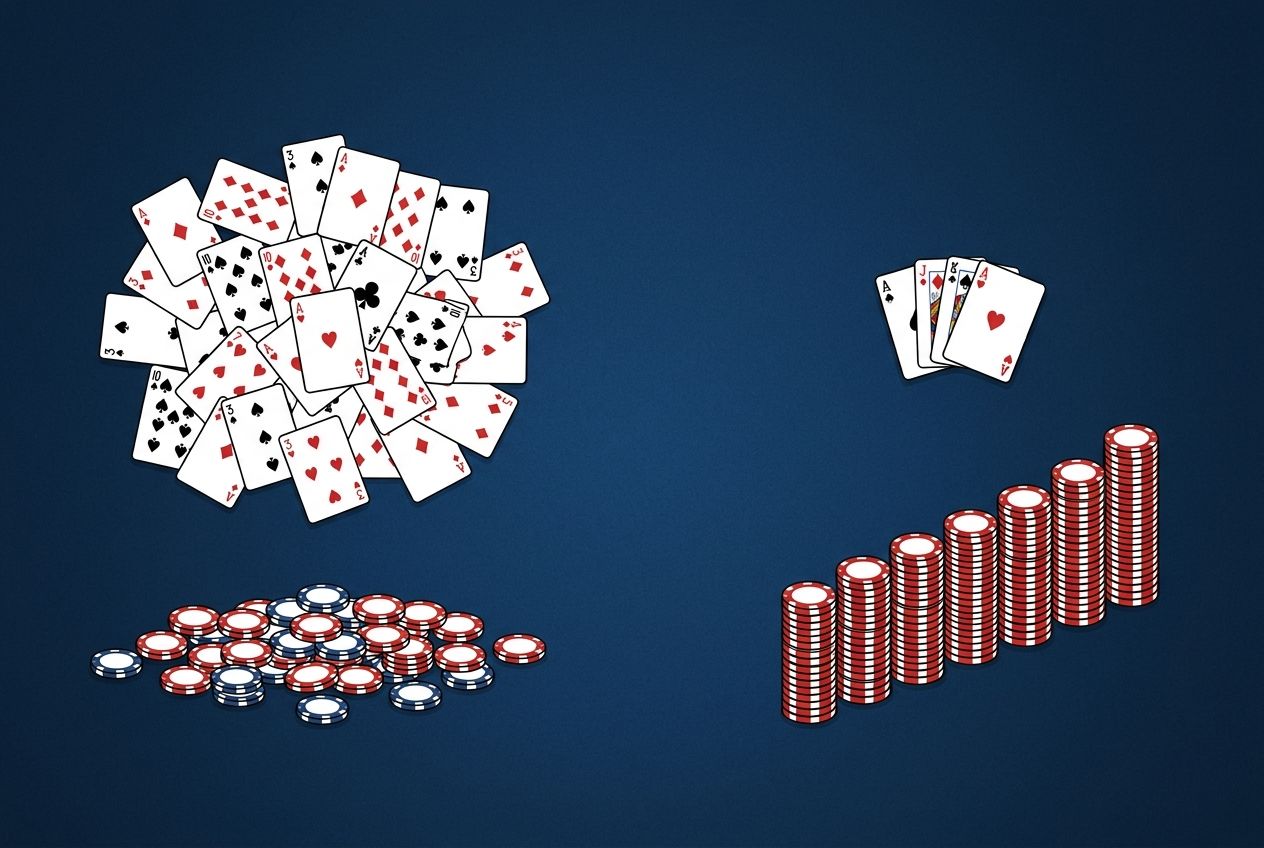
Study
Practice baseline and exploit adjustments in Study
Train how to start from a balanced default and then adjust against over-folding, over-calling, and passive opponents in realistic scenarios.
Final Summary
GTO keeps your structure stable. Exploit turns stable structure into extra profit when the table gives you a repeated reason.
- Start from a baseline.
- Deviate only when the leak is real and repeated.
- Keep exploit adjustments clear and narrow, not chaotic.
Study
Related Study lessons
Related articles
Continue with another angle on the same decision.
Money-Making Spots and Money-Burning Spots in Poker
Poker profit comes less from flashy hero moments and more from stepping into the right recurring structures. This guide breaks down where money tends to pile up and where it most often gets burned.
A System That Connects Exploits, Playbooks, and Reviews
Strong players do not just learn isolated ideas. They connect opponent exploits, personal playbook rules, and review outputs into a loop that changes the next session.
Poker Tilt Early Warnings: When to Stop a Session
Tilt often damages the decision process before it feels like anger. Use five observable signals and a Green-Yellow-Red recovery test to choose between continuing, pausing, and ending a session.