Blog
Which Starting Hands Are Actually Worth Playing?
A beginner-friendly preflop guide explaining premium hands, marginal hands, and how position changes starting-hand value in practical 6-max poker.
A good starting hand is not just a hand that looks nice. It is a hand that can keep earning money after the flop too
Starting-hand selection improves fast once you stop asking only "Is this hand pretty?" and start asking "Can this hand survive real action?"
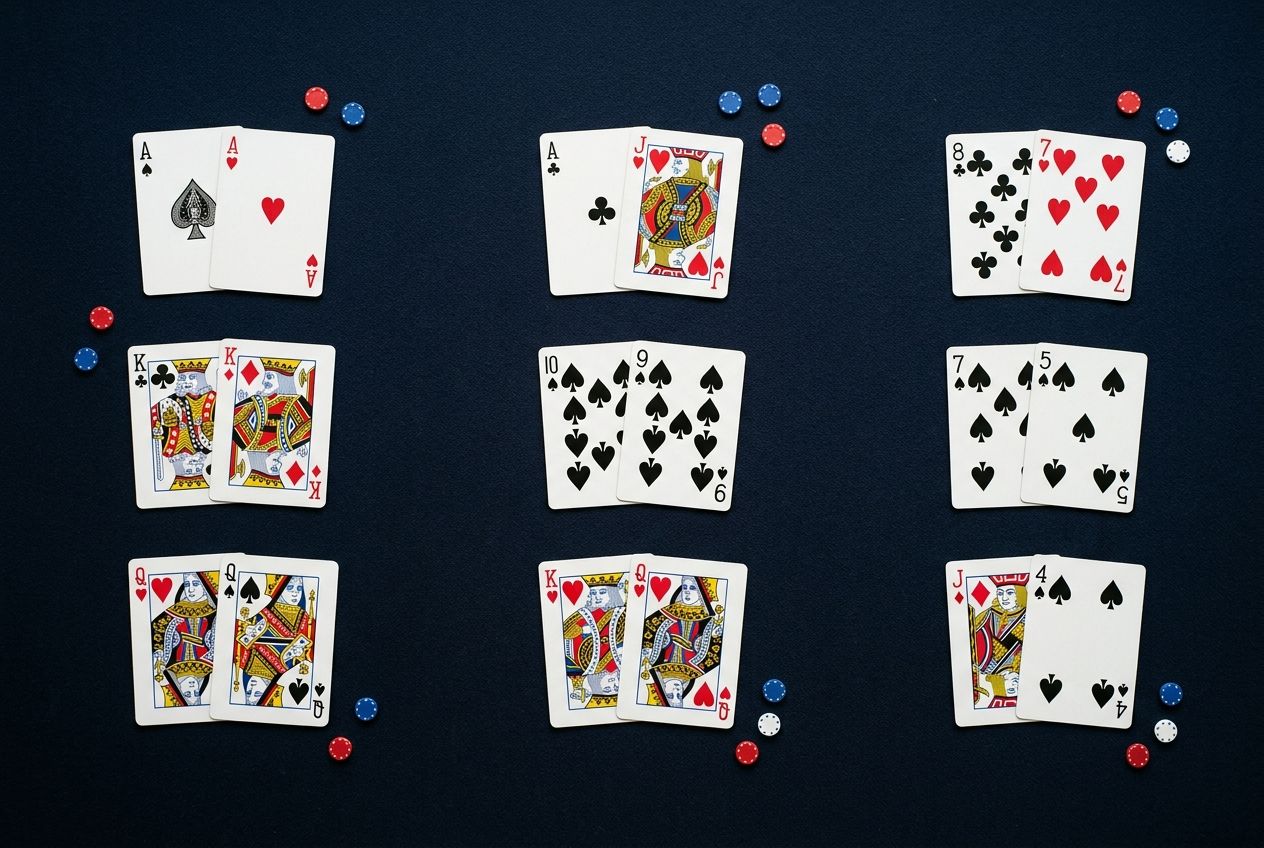
One of the earliest beginner questions is simple: is this hand good enough? That is a fair question, but poker does not answer it with hand beauty alone. A hand like A K is clearly strong. A hand like K J may look attractive, but it becomes much less attractive once position, domination, and pressure enter the picture.
That is exactly the beginner split to learn first:
- why premium hands stay strong,
- why marginal hands create expensive trouble,
- and why the same hand changes value by position.
Premium hands are powerful because they stay stable under pressure
A premium hand is not only likely to hit strong pairs. It also avoids being dominated as often when the pot grows.
Hands like AA, KK, QQ, AK, and AQs are premium because they do several things well at once:
- they make strong top pairs or overpairs,
- their kickers hold up better,
- they handle preflop pressure more cleanly,
- and they still make sense in larger pots.
That is why they are so much easier to play. They do not just win more often. They win more cleanly.
Marginal hands are often more dangerous than weak trash
Beginners usually lose more money with "almost good" hands than with obviously bad hands.
Why? Because obviously bad hands are easy to fold. The real trouble comes from hands like:
KToQJoA9oJTo
These hands often make second-best top pairs, run into domination, and perform poorly from bad positions. They look playable, which makes them harder to release, but that appearance is exactly what makes them costly.
Position changes the value of the same starting hand
A hand is not just a hand. It is a hand from a seat.
ATs can be too marginal in one position and a clean open in another. K9o may be a fold in early position but a reasonable button steal. The reason is not magic. The reason is structure:
- fewer players remain behind,
- steal EV becomes more important,
- 3-bet pressure changes,
- and postflop position improves realization.
That means beginner starting-hand logic should look like this:
| Hand family | Practical beginner view |
|---|---|
| Premium pairs and strong big aces | Strong opens almost everywhere |
| Suited broadways and suited aces | Gain value as position improves |
| Medium offsuit broadways | Much more position-sensitive |
| Weak offsuit trash | Still folds even when seats loosen |
The biggest beginner trap is the "looks okay" hand
The most expensive hand class is often not the worst-looking one, but the hand that feels just good enough to continue when it should not.
This is why so many beginners struggle with broadway-looking marginal hands. They hit top pair often enough to feel playable, but not cleanly enough to stay strong.
That is the real value of early hand selection study. It teaches you not only what to play, but what to respect.
A practical way to evaluate a starting hand
Ask these four questions:
- If I make top pair, will my kicker usually hold up?
- Does suitedness or connectivity improve the hand's realization?
- Is this hand still good from earlier positions, or only from later ones?
- If I get called or 3-bet, can I still explain why this hand entered the pot?
If those answers are weak, beginner poker usually prefers the fold.
Study
Practice good and bad starting hands in Study
Train how premium hands, marginal hands, and positional value shifts affect preflop decisions through guided scenarios.
Final Summary
Strong starting-hand selection comes from structure, not from card cosmetics.
Keep these three action rules:
- Premium hands are strong because they remain structurally strong under pressure.
- Marginal broadway hands are often more dangerous than they first appear.
- Position can upgrade or downgrade the same hand dramatically.
That framework alone makes preflop choices much more disciplined.
Study
Related Study lessons
Related articles
Continue with another angle on the same decision.
EP Open Discipline and LP Expansion Playbook
UTG and BTN opens are not the same skill. This playbook explains why early-position discipline removes domination risk while late-position expansion captures steal EV and positional value.
Starting Hands, Open Raises, and Why Limping Causes Problems
A starting hand is only “good” inside a seat, stack, and plan. Once you understand that, open raising becomes a much cleaner default.
How a Hold'em Hand Flows at the Table
A hand becomes much easier once you can instantly spot the button, the blinds, and who acts first on each street.