Blog
3-Bet and 4-Bet Response Basics
A practical beginner guide to what 3-bets and 4-bets mean, how to sort hands into response buckets, and why seat, size, and position matter.
A 3-bet is not just a bigger raise. It is a stronger range statement.
The first useful habit in 3-bet pots is to stop asking “Can I fight back?” and start asking “Which response bucket does this hand belong to?”
Beginners often experience 3-bets as emotional events. They open, someone re-raises, and suddenly the hand feels personal. That is why many players either overfold out of frustration or overcall because folding feels weak.
But a 3-bet pot becomes much easier when you stop treating it like a duel and start treating it like a range problem. A 3-bet usually says two things at once:
- the re-raiser is representing a tighter or more aggressive range than a normal open,
- and the original raiser now has to reorganize their own opening range into clearer response groups.
That reorganization is the real skill. Once you learn to divide hands into fold, call, and 4-bet buckets, 3-bet spots stop feeling chaotic.
Start with the three response buckets
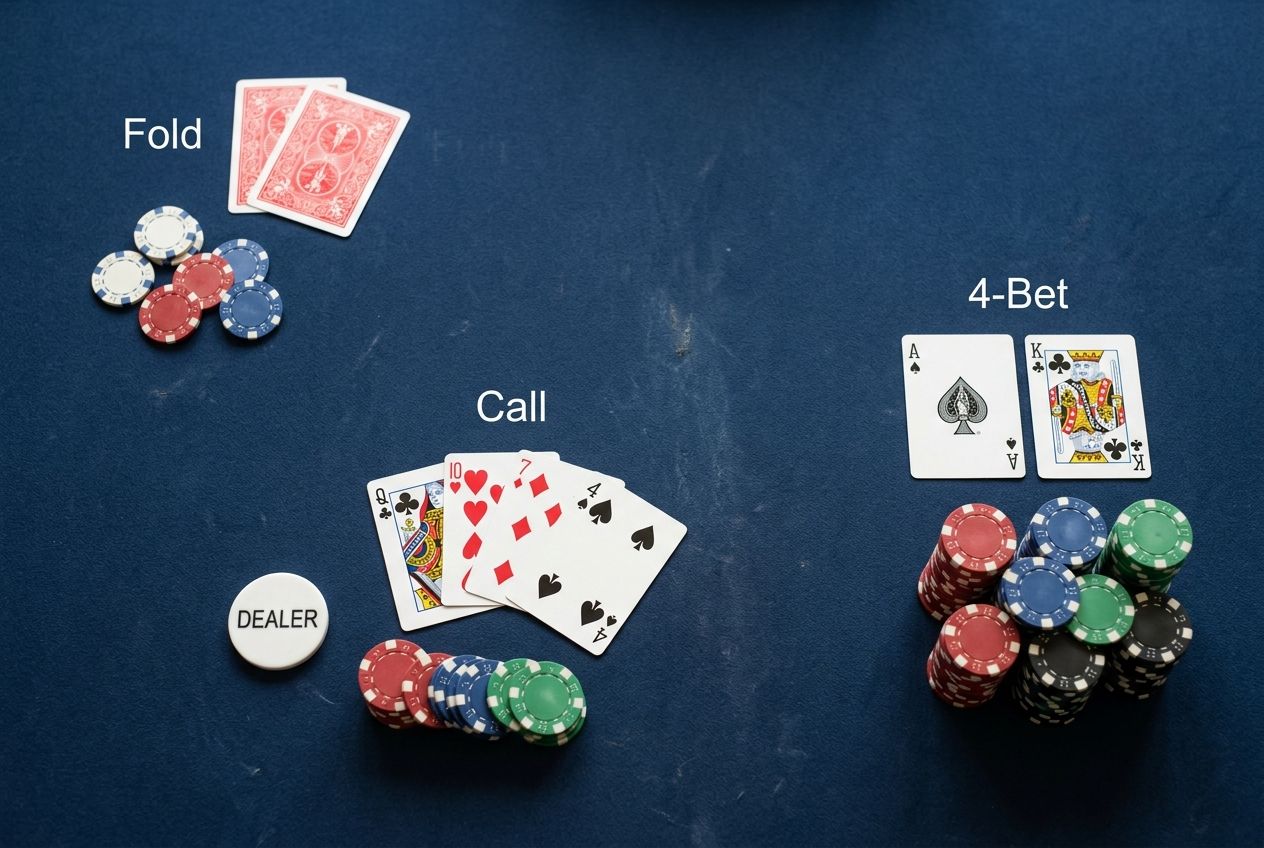
Most preflop 3-bet decisions become clearer once every hand is sorted into fold, call, or 4-bet before the action begins.
A clean beginner framework is:
- Fold the weakest opens that cannot continue profitably.
- Call with hands that retain enough postflop playability.
- 4-bet with hands that want more value or leverage.
This sounds simple, but it matters because many players never separate these buckets in advance. They only react after the 3-bet happens. That leads to emotional decisions instead of structured ones.
The reason bucket thinking works is that it forces consistency. If you already know which parts of your opening range continue versus a button 3-bet, you do not need to improvise with every individual combo.
Why flat calling too much becomes expensive
The most common beginner leak in these spots is overcalling. A player opens, faces a 3-bet, looks down at a hand that feels “too good to fold,” and calls almost by default.
That becomes expensive because wide calls create three linked problems:
- the pot gets bigger quickly,
- the stronger range often keeps initiative,
- and out-of-position play becomes much harder after the flop.
This is especially punishing from early position or the blinds. You are not just calling more chips. You are agreeing to play a swollen pot with less information and less leverage.
That is why the clean question is not:
“Can this hand survive a flop?”
The better question is:
“Does this hand belong in a call bucket against this seat, size, and position?”
Seat and size matter more than beginners expect
A 3-bet from the button is not the same as a 3-bet from the small blind. A small sizing is not the same as a large one. Those differences matter because they change both the likely range and your postflop conditions.
For example:
- a tighter position usually implies a stronger value-heavy range,
- a later position may contain more aggressive re-steals,
- a larger 3-bet size often gives you worse direct odds to continue,
- and out-of-position postflop play lowers the value of many medium-strength hands.
So when you build response buckets, always attach them to a spot. A hand may be a comfortable continue in one seat-versus-seat battle and a clean fold in another.
A practical beginner table
| Situation | Cleaner first instinct |
|---|---|
| Weak open facing clear strength | Fold more often |
| Playable hand with position and reasonable sizing | Call sometimes |
| Strong value hand or planned bluff candidate | 4-bet more often |
| Marginal hand out of position in a big pot | Avoid automatic calls |
This table is not a solved chart. It is a discipline tool. It prevents the most common leak, which is treating every “decent-looking” hand as if it deserves to continue.
What a 4-bet is actually doing
Beginners sometimes think a 4-bet is only for premium value hands like aces or kings. In very early learning stages, that is a fine place to start. But conceptually, a 4-bet is doing one of two jobs:
- extracting value from a range that can continue worse,
- or applying leverage to the part of villain’s 3-bet range that cannot continue comfortably.
You do not need to build a sophisticated mixed strategy on day one. The practical lesson is simpler: a 4-bet is not random aggression. It is a range action with a clear purpose.
A useful decision order before you continue
If you face a 3-bet, run through this sequence:
- Which seat 3-bet me?
- What size did they choose?
- Will I be in position or out of position after the flop?
- Does this hand belong in my fold, call, or 4-bet bucket here?
- If I call, do I have a clear plan for playing a larger pot?
That final question matters a lot. Calling because a hand “looks pretty” is not a plan. Calling because the hand plays well in position against this size is a plan.
Beginner mistakes that cost the most
In 3-bet pots, the expensive mistake is rarely “being too passive” in the abstract. It is continuing without a defined bucket.
The most common leaks are:
- Calling too wide because folding feels weak
This creates difficult postflop spots with dominated or poorly structured hands.
- Treating every 3-bet the same
Seat, size, and position change the meaning of the re-raise.
- 4-betting emotionally
A 4-bet should represent value or leverage, not frustration.
- Ignoring position after the call
Many hands lose value quickly when they must defend a large pot out of position.
The goal is not bravery. The goal is structure.
3-bet pots feel stressful when every response is improvised. They feel manageable when hands are already sorted into response buckets before the pressure arrives.
That is why this topic improves so much with repetition. The more often you see the same seat-versus-seat patterns, the more natural it becomes to say:
- this part folds,
- this part calls,
- this part 4-bets.
Study
Train 3-bet response patterns
Walk through common 3-bet and 4-bet spots in Study so your response feels structured instead of reactive.
Build the response tree before the action speeds up
Preflop pressure becomes easier when the decision is already organized before villain clicks the raise button.
Study is useful here because the same 3-bet patterns appear over and over. Once you stop framing these spots as ego battles and start framing them as bucket decisions, preflop becomes calmer, faster, and much more consistent.
Study
Related Study lessons
Related articles
Continue with another angle on the same decision.
Squeeze and 4-Bet War Playbook
Not every pretty suited hand should squeeze, and not every blocker hand should continue versus a 5-bet jam. This playbook connects linear 3-bets, squeeze EV, value 4-bets, and bluff 4-bets into one preflop system.
EP Open Discipline and LP Expansion Playbook
UTG and BTN opens are not the same skill. This playbook explains why early-position discipline removes domination risk while late-position expansion captures steal EV and positional value.
Thinking in Ranges for Beginners
Poker gets clearer when you stop guessing one exact combo and start comparing whole groups of hands that can still exist.