Blog
Showdown, Kickers, and Best Five Cards
A beginner guide explaining when showdown occurs, how best five cards work in hold'em, and how kickers affect one-pair and board-based comparisons.
Hold'em does not compare your two hole cards. It compares the best five-card hand you can build
Showdown becomes much easier once you stop thinking "my two cards versus their two cards" and start thinking "best five out of seven."
Many beginners know the names of the hand rankings but still get confused at showdown. The reason is simple: hold'em does not award the pot based on your two private cards alone. It uses your two hole cards plus the five board cards, and from those seven cards it selects the strongest possible five-card hand.
That is the real key behind showdown basics:
- when showdown actually happens,
- how best five cards are chosen,
- when kickers matter,
- and how board strength changes everything.
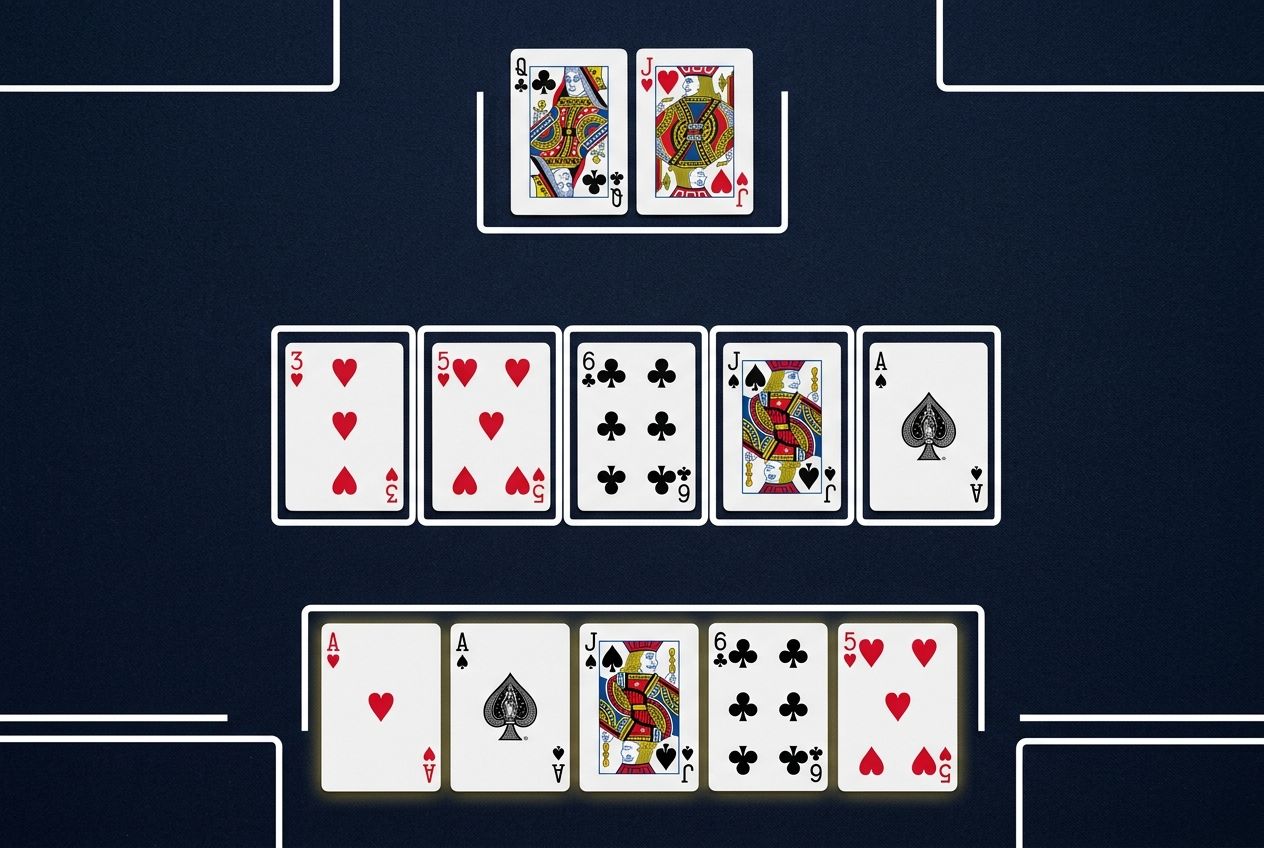
Showdown only happens if action is over and more than one player remains
Showdown is not an automatic ritual at the end of every hand. It is a final comparison step that happens only when players still remain after the last action.
If someone bets river and everyone folds, there is no showdown. One player already won without needing to reveal cards. If two players check river and both remain, then showdown happens because the hand still needs a winner.
This sounds basic, but it removes a lot of beginner confusion immediately.
The best-five-cards rule solves most showdown confusion
Final hand strength is always based on five cards, never six or seven.
Suppose you hold A♠ K♠ and the board is A♦ 7♣ 7♥ 2♠ 2♦.
Your final hand is not "ace-king plus the board." Your final hand is the best five-card combination:
A A 7 7 K
That means:
- you do not always use both hole cards,
- you do not always use the whole board,
- and you always select only the strongest five-card combination available.
This is the most important beginner showdown rule.
Kickers matter only when the main hand class is tied
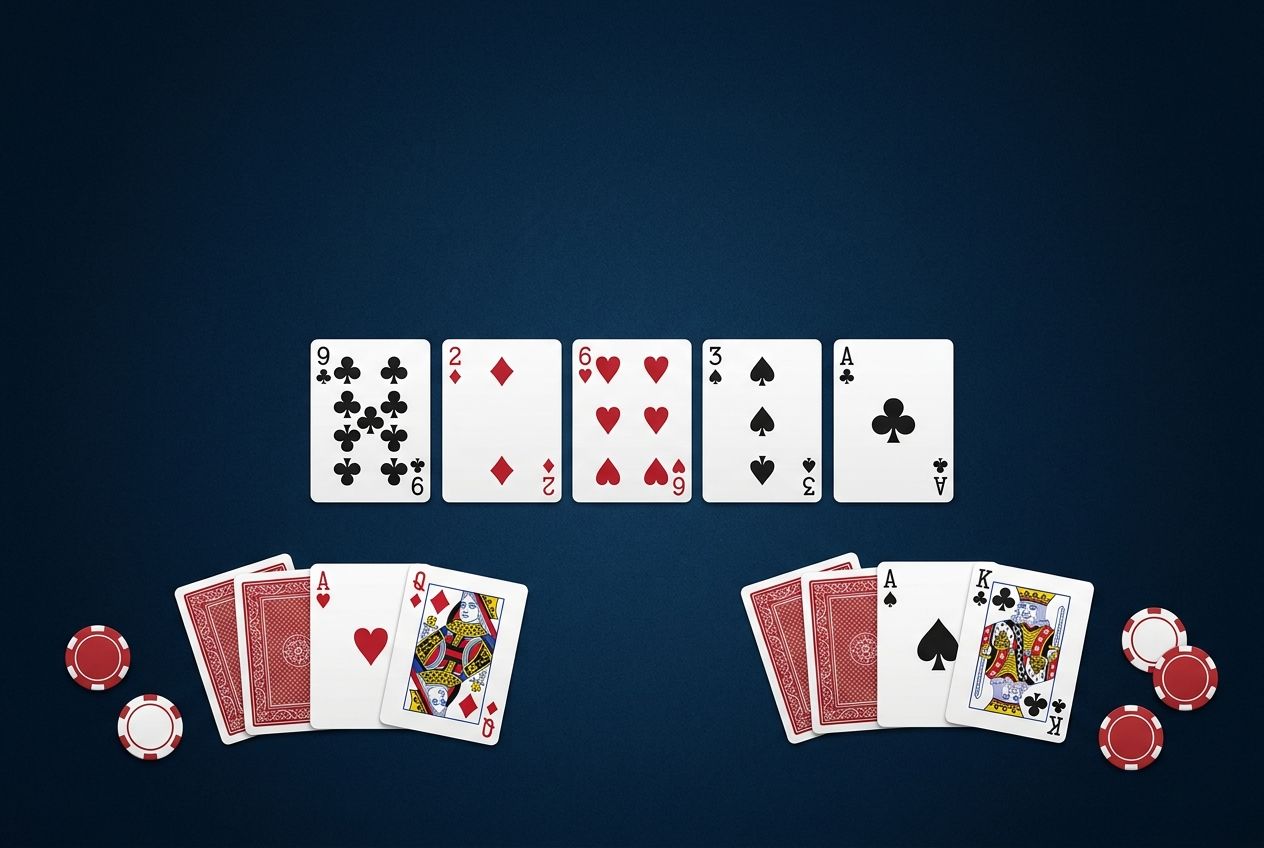
A kicker is not a bonus card that always matters. It matters only when both players share the same main made hand and the remaining high card decides the winner.
For example:
- Player A has
A K - Player B has
A J - Board is
A 8 5 3 2
Both players made one pair of aces. The pair is tied. So the next highest card matters. The king beats the jack, which means Player A wins. The king is the better kicker.
But if the board itself is already extremely strong, the hole-card kicker can matter much less or not at all.
Sometimes the board itself gives everyone the same hand
One of the biggest beginner mistakes is assuming a personal hole-card story still matters even when the board nearly builds the full hand by itself.
Imagine a board like K K Q Q A. If no player makes something better, many hands simply play the board. That means very different hole cards may still chop if neither player improves beyond the shared board strength.
That is why hold'em can feel strange at first. Your hand may look important, but sometimes the board has already done most of the work.
Trips, two pair, full house, and board-based hands must be separated carefully
Here is a useful beginner comparison table:
| Situation | Correct reading |
|---|---|
| Paired board plus one matching hole card | Can create trips |
| Paired board plus a pocket pair in your hand | Can create a full house |
| Board already contains two pair | Players may share the two pair and compare kickers |
| Same pair strength on both sides | Kicker may decide it |
For example, on 9 9 4 4 K, a hand like A 2 makes 9 9 4 4 A. But 4 2 makes 9 9 4 4 4, which is a full house. The board is the same, but the final five-card hand is completely different.
The most common beginner showdown mistakes
Showdown mistakes usually happen because players stop halfway through the best-five process instead of finishing the full comparison.
Common errors:
- assuming both hole cards must always be used,
- assuming identical pairs always mean a chop,
- forgetting that strong boards can neutralize hole-card differences,
- confusing trips, two pair, and full house structures.
All of these improve once the player follows a consistent comparison order.
A simple showdown checklist
Use this order:
- Identify the strongest hand class available.
- Choose the best five cards for each player.
- Compare whether both players have the same hand class.
- If they do, compare the remaining relevant kickers.
- Check whether the board itself already creates the same final hand for everyone.
That order makes showdown much more predictable.
Study
Practice showdown and kicker decisions in Study
Learn when showdown happens, how best five cards are chosen, and when kickers matter through repeated beginner decision scenes.
Final Summary
Showdown is not about comparing two private hands. It is about finishing the best-five-card puzzle correctly.
Keep these three action rules:
- Showdown happens only when action is complete and more than one player remains.
- Hold'em always compares the best five cards out of seven.
- Kickers matter only when the main hand class is tied and the remaining card ranking still differs.
Once those rules are clear, most beginner showdown confusion disappears.
Study
Related Study lessons
Related articles
Continue with another angle on the same decision.
How a Hold'em Hand Flows at the Table
A hand becomes much easier once you can instantly spot the button, the blinds, and who acts first on each street.
How to Read Poker Cards and Hand Notation
From ranks and suits to suited, offsuit, pocket pairs, and `AKs` style notation, this guide helps beginners read poker shorthand without hesitation.
Check, Call, Bet, and Raise Explained Simply
Poker actions become much easier when you separate actions that start pressure from actions that answer pressure.