Blog
Semi-Bluff EV and Draw Aggression Framework
An advanced guide to semi-bluff EV, explaining how to classify monster draws, medium draws, and pair-plus-draw structures through fold equity, realized equity, and aggression quality.
A draw is not an aggressive hand just because it can improve. It becomes aggressive when fold equity and realized equity align
Semi-bluffing is not about having outs. It is about having enough immediate fold equity and enough future equity for aggression to outperform passivity.
Many players learn a rough truth: strong draws can attack, weak draws often call. That shortcut is useful, but still too broad for real decision-making. Draws do not all create EV in the same way.
The real split is this:
- monster draws often gain huge EV from attacking,
- medium-strength draws may realize better through calls,
- pair-plus-draw hands can attack even more confidently because they already own showdown value.
That means good draw play starts from classification, not from emotion.
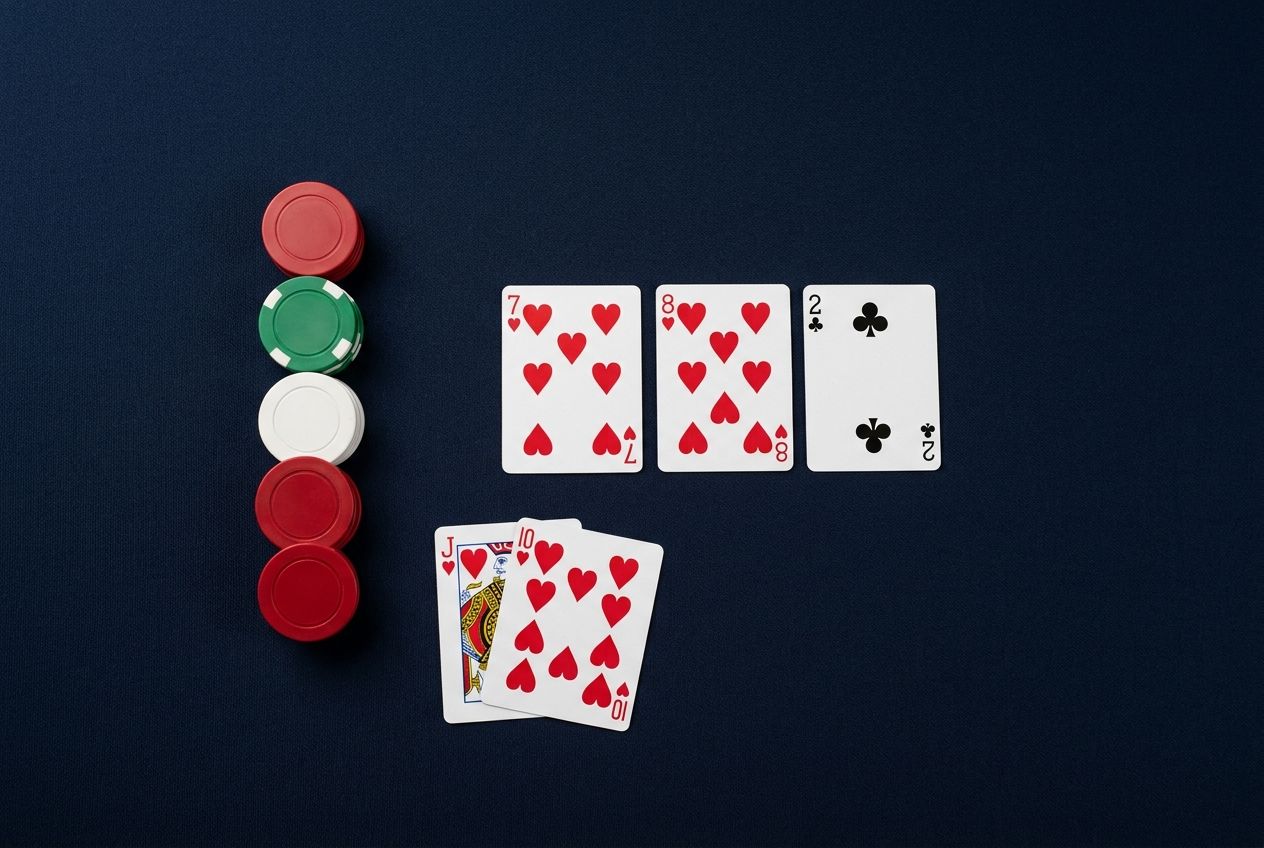
Monster draws often gain more from aggression than from patience
A monster draw wins in two ways at once: it can take the pot immediately, and it still carries excellent equity when called.
Think about JhTh on 9h 8c 2h. You already hold both a flush draw and an open-ended straight draw. That means a raise creates two strong EV engines:
- immediate fold equity,
- and excellent future equity when called.
That is why monster draws often convert into semi-bluffs so naturally. They do not need the opponent to fold every time. They remain healthy even when the pot continues.
Medium draws are not obligated to attack
A draw can be playable without being an ideal raise candidate.
Take 98h on Kd 7h 2h. Yes, it is a flush draw. But it is not a nut flush draw. It is more vulnerable to pressure, and it may not enjoy getting pushed off its equity after raising. In many cases, this kind of hand prefers to call, take the price, and realize on later streets.
That creates the second practical rule:
Do not confuse draw presence with raise quality
Some draws are profitable because they attack. Others are profitable because they continue cheaply.
Pair-plus-draw hands are often the healthiest aggression candidates of all
Pair-plus-draw structures combine showdown value with strong improvement paths, which often makes them more robust attackers than pure draws.
Now imagine QhJh on Jh 9h 3c, then the turn brings 8s. Suddenly the hand is not just top pair. It also carries flush and straight pressure. When such a hand raises, it can:
- pressure weaker made hands immediately,
- continue with strong equity when called,
- and still retain real showdown value if the hand slows down later.
That is why pair-plus-draw hands often deserve more aggression, not less.
A simple live framework for semi-bluff EV
During a real session, you do not need full numeric precision. You need a few fast filters:
- If I raise, can I win the pot now often enough?
- If I get called, does my hand remain healthy?
- If I get pushed back on, is the draw still comfortable?
- Do I also carry pair value or useful blockers?
Those four questions let you separate the major draw classes:
| Draw type | Practical default |
|---|---|
| Monster draw | High aggression candidate |
| Medium draw | Often realizes better through calls |
| Pair-plus-draw | Especially strong attack candidate |
| Weak draw with poor blocker quality | Beware low-quality aggression |
The biggest draw mistake is usually binary thinking
Players often fail because they treat every draw as either "must raise" or "must call," instead of asking what kind of EV engine the draw actually has.
Common expensive errors:
- slow-playing monster draws into under-realized EV,
- over-raising medium draws that dislike pressure,
- treating pair-plus-draw hands like fragile bluff-catchers,
- or semi-bluffing in nodes with little real fold equity.
Each of those mistakes disappears faster once draw play is broken into hand classes.
The best session rules are short enough to remember under pressure
In practice, this topic can be compressed into a few useful lines:
Monster draws often prefer raising to callingMedium draws are not mandatory semi-bluffsPair-plus-draw hands can attack especially wellSemi-bluff only when fold equity and future equity both matter
Study
Practice semi-bluff EV and draw aggression in Study
Train how monster draws, medium draws, and pair-plus-draw structures change your flop and turn aggression through fold equity and realized equity drills.
Final Summary
Semi-bluffing is not random aggression with outs. It is structured aggression with the right EV profile.
Keep these three action rules:
- Attack more often with monster draws because they win in two ways.
- Let medium draws realize through calls when aggression quality is weak.
- Upgrade pair-plus-draw hands into premium aggressive candidates.
That framework alone makes draw play much more disciplined and much more profitable.
Study
Related Study lessons
Related articles
Continue with another angle on the same decision.
A Good Hand Does Not Always Mean You Should Call All-In
Hands like AKo, AQs, JJ, and TT are strong, but they are not automatic all-in calls in every spot. This guide explains why good-looking hands and good all-in calls are different things, and how to think about coinflips in practice.
How to Understand MDF and Use It at the Table
MDF is not a chart you memorize for its own sake. It is a defense baseline that helps you understand why small bets require wider defense and big bets allow narrower defense.
MDF, SPR, and Commitment Basics
MDF and SPR are not separate trivia topics. Together they explain how often you defend, how big your hand really is in the pot, and when commitment becomes natural.