Blog
Range Advantage and Nut Advantage Explained
An intermediate guide explaining the difference between range advantage and nut advantage and how both affect c-bet frequency, sizing, and postflop pressure.
Range advantage and nut advantage are related, but they are not the same thing
Good flop strategy becomes much clearer once you separate who is ahead overall from who owns the top of the tree.
One of the most important postflop upgrades is this: average edge and top-end edge are different questions.
Many intermediate players look at a board and make one fast conclusion: "the opener has the advantage" or "the caller hits this board better." Real strategy is more precise than that. One player can be ahead on average while the other player holds more of the absolute strongest hands.
Once you understand that split, several confusing strategy ideas become easier:
- why some flops allow wide small c-bets,
- why some textures punish autopilot continuation betting,
- why size and frequency change even when the preflop aggressor stays the same.
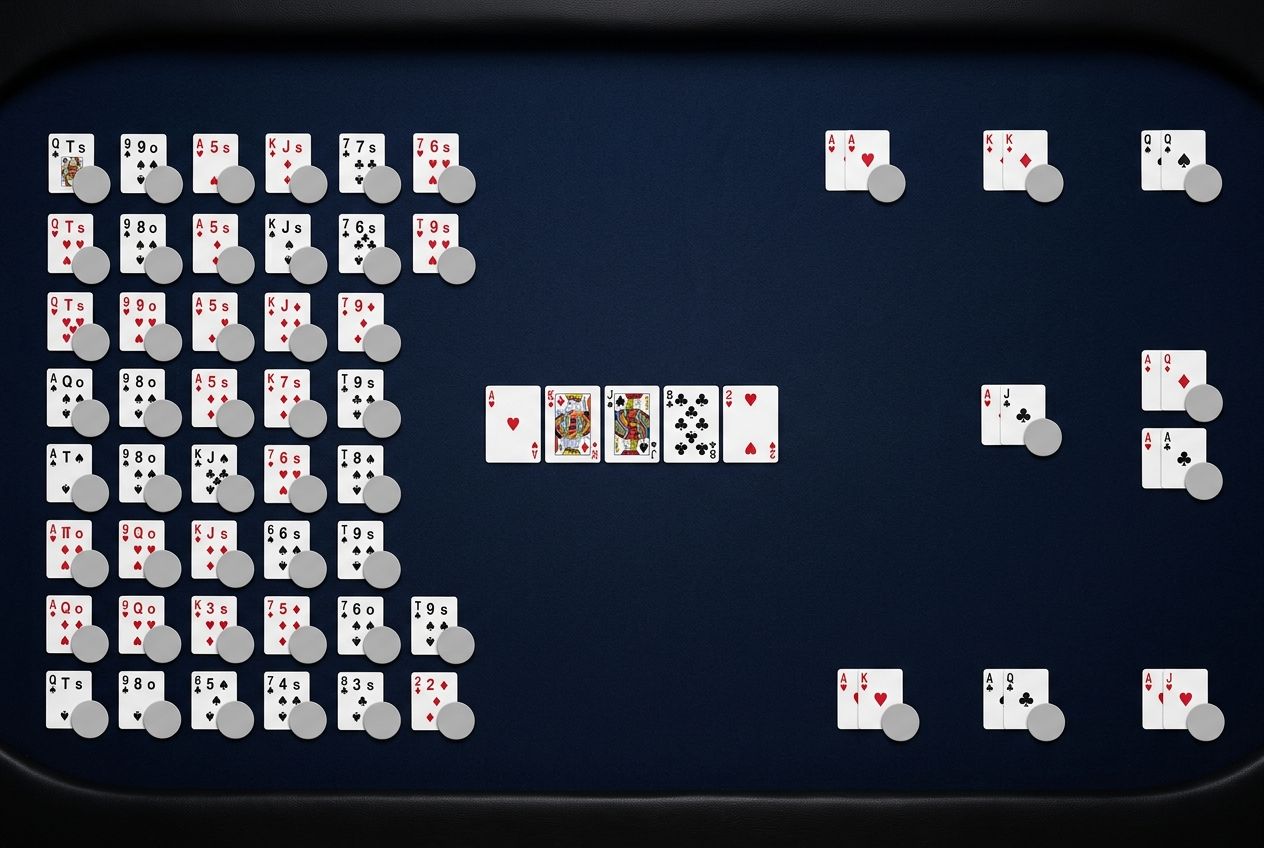
Range advantage means the overall distribution is stronger
If one player holds more top pairs, overpairs, and strong high-card coverage across the whole range, that player may have range advantage.
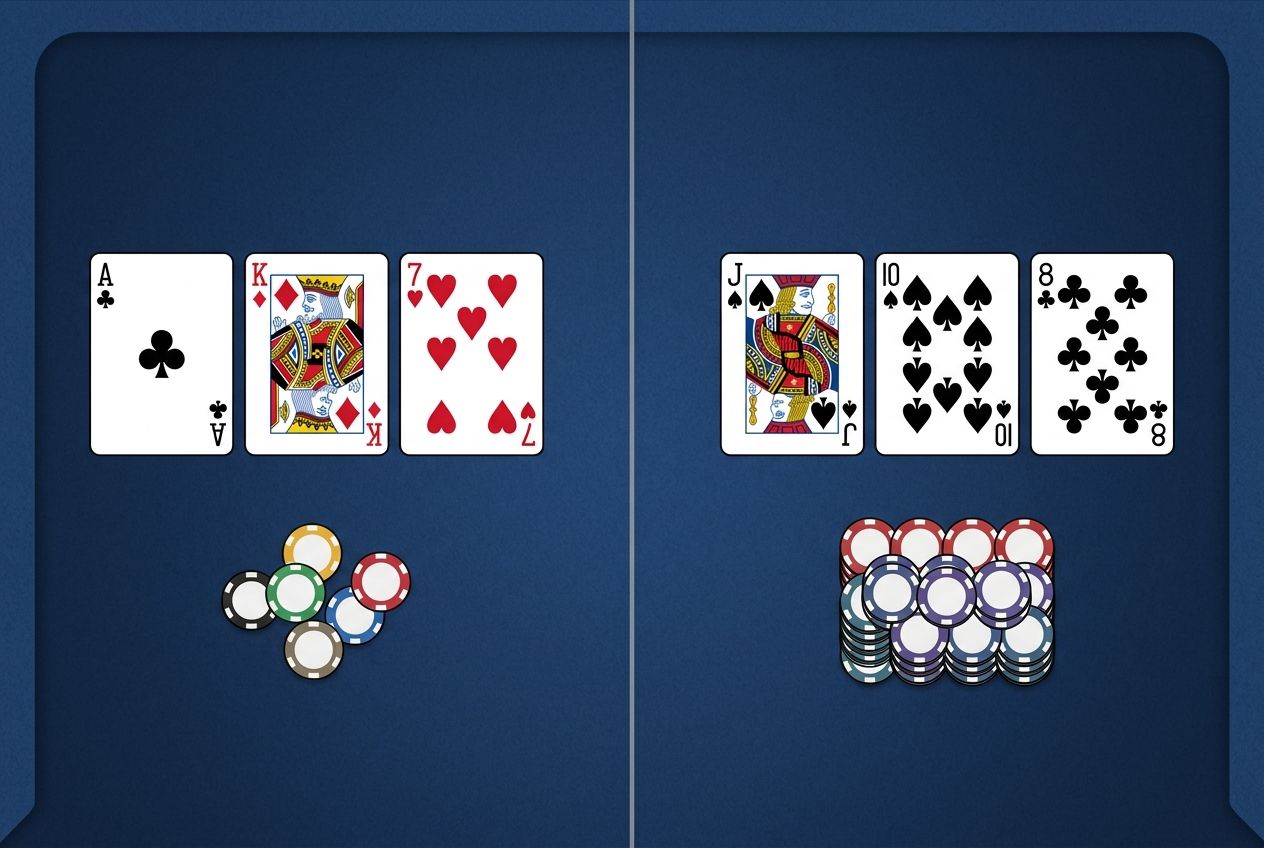
Consider a button open versus big blind call on an A-7-2 rainbow flop. The opener usually carries more AK, AQ, AJ, stronger ace-x, and more premium high-card density. That means the opener is often ahead on average across the full distribution.
That is why small c-bets at healthy frequency are common on ace-high dry boards.
Nut advantage means the strongest possible hands cluster more heavily in one range
Nut advantage is not about average strength. It is about who holds more two pair, sets, straights, nut flushes, and other top-end structures.
Think about 8♠ 7♠ 6♦. The opener may still retain overpairs and strong broadway overcards, but the big blind can arrive with more two pair, sets, straights, and very strong combo draws. In that case, the opener may still have some average edge while losing the top-end battle.
Being ahead on average does not automatically mean you control the strongest part of the tree.
Why the distinction matters
If you blend both ideas together, you end up with one shallow rule: opener is ahead, so bet a lot. Real flop strategy is more refined than that.
- strong range advantage often supports small size and wider frequency,
- weak nut advantage or defender nut advantage asks for more caution.
| Board type | Range advantage side | Nut advantage side | Practical default |
|---|---|---|---|
| A-high dry | Usually opener | Often opener too | Wide small c-bets make sense |
| Mid connected wet | Can be mixed | Defender often gains top-end density | Be more selective with size and frequency |
| Low paired board | Opener may keep average edge | Top-end interaction becomes more complex | Avoid autopilot pressure |
This table matters because "who hit the board better?" is too vague. Average edge and top-end edge are separate strategic questions.
Why c-bet size and frequency change so much
When range advantage is strong, the defender struggles against broad pressure. That makes small sizing and wider betting more attractive. When nut advantage shifts toward the defender, over-aggression becomes more dangerous because strong raises and stronger continuing ranges appear more often.
That is why c-betting is not mainly about "I was the preflop raiser." It is about how overall range strength and top-end strength interact on the specific board.
Practical questions to ask on the flop
You can make the concept much more usable by asking:
- Who has more top pairs and overpairs?
- Who has more two pair, sets, and straights?
- Can I pressure widely with a small size without being punished too hard?
- Does a big size expose that my top-end density is weak?
These questions sound theoretical, but they are really a practical c-bet checklist.
Common misunderstandings
The first mistake is assuming every ace-high flop belongs to the opener in every way. Low-card interaction, kicker quality, and backdoor structure still matter.
The second mistake is assuming every connected board belongs to the defender. Pot type, preflop ranges, and stack depth can change the picture.
The third mistake is thinking weak nut advantage means you must always check. Not necessarily. You may still pressure if your average edge is strong, but the pressure usually needs more discipline.
Study
Practice range and nut advantage reading in Study
Train how to separate broad range edge from top-end nut edge on real boards and connect that to c-bet decisions.
Final Summary
Range advantage is about the whole range. Nut advantage is about the strongest hands inside it.
- Separate average edge from top-end edge.
- Use range advantage to think about frequency.
- Use nut advantage to think about how comfortably pressure can continue.
Study
Related Study lessons
Related articles
Continue with another angle on the same decision.
Dry Board C-Bet Playbook
A-high, K-high, and Q-high dry boards are not the same auto-bet node. This guide turns range advantage, nut advantage, and check-back protection into a practical postflop playbook.
Board Texture, C-Bets, and Simple Barrel Rules
Dry boards and wet boards are not just visual labels. They change how often you can bet, how large you should size, and whether your turn plan still makes sense.
River Bluff Catching: Rebuild Value and Missed Draws
A missed draw is not automatically a bluff. Price the call, count line-consistent value, and include only missed draws that actually bet.