Blog
Pot Odds, Outs, and Equity With Real Examples
A practical beginner guide to outs, pot odds, equity shortcuts, and how to turn quick math into better call-or-fold decisions.
Poker math gets easier when you compare two percentages
Most drawing decisions become clearer when you compare only two numbers: your chance to improve and the price you are paying.
For many beginners, poker math feels like a separate skill from the rest of the game. They understand position, hand strength, and basic action order, but the moment someone says "pot odds" or "equity," everything suddenly feels slower and more intimidating.
The good news is that beginner poker math does not require perfect calculation. In most real hands, you are not trying to solve a full game tree. You are trying to answer one practical question:
- how often will my hand improve,
- how much must I pay right now,
- and is the price good enough?
That is why outs, equity, and pot odds fit together so well. Outs estimate how many cards help you. Equity converts that into a rough chance to win or improve. Pot odds tell you the minimum chance you need in order to justify a call.
Start with outs before you start with formulas
Count the cards that truly improve your hand first. Pot odds become useful only after your outs are realistic.
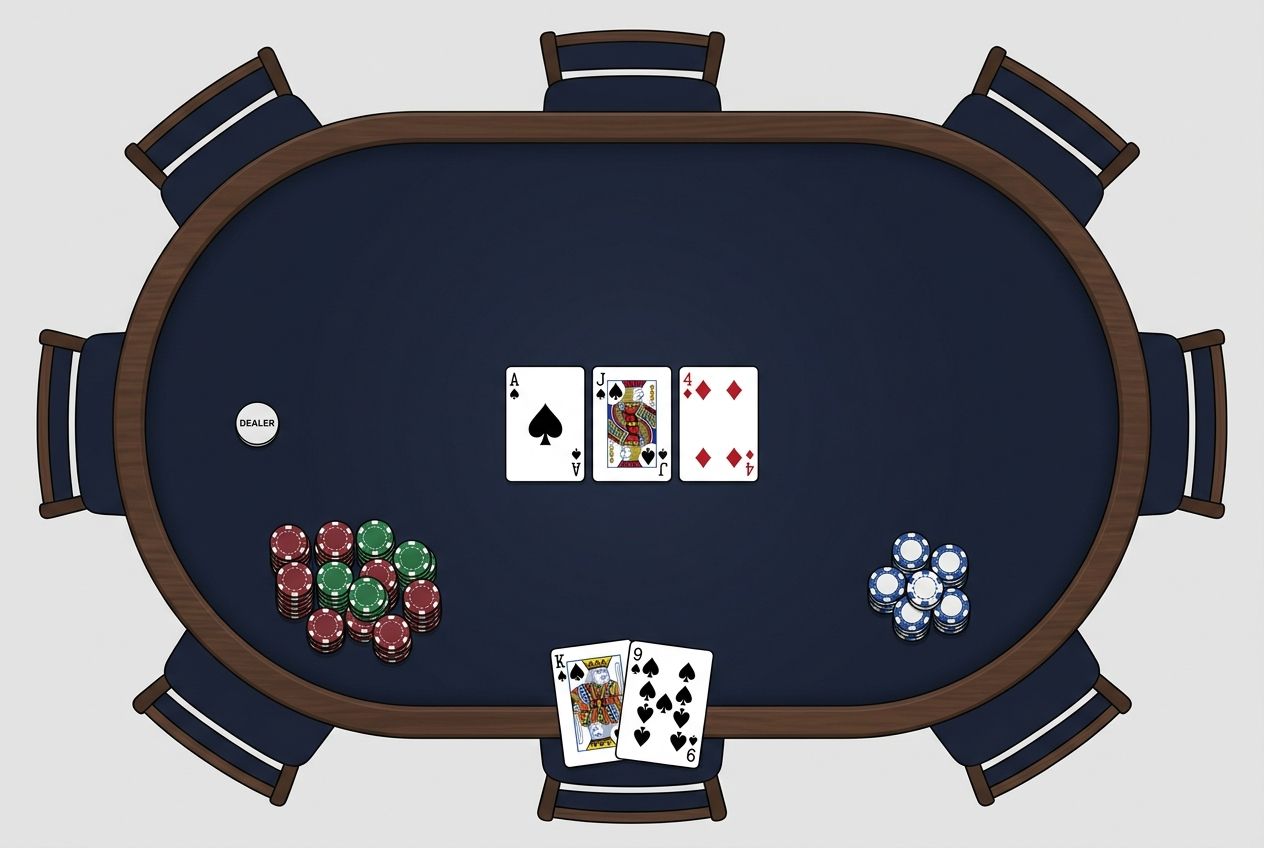
An out is a remaining unseen card that improves your hand enough to matter. If you have a four-flush on the flop, the first shortcut many players learn is easy:
- nine remaining cards complete the flush,
- so you have 9 outs,
- and that gives you a rough way to estimate your chance to improve.
This sounds simple, but the most common beginner leak appears right here. Players often count every "nice looking" card as an out, even when some of those cards can still leave them second best. That means the first step is not just counting fast. It is counting honestly.
For example, if you have a flush draw on a paired board, or a straight draw where some cards also complete a stronger draw for your opponent, the clean textbook number may be slightly too optimistic. At beginner level that is not a reason to panic. It is simply a reason to remember that clean outs are better than inflated outs.
The 4-and-2 rule is a shortcut, not a religion
The most useful shortcut for beginners is the 4-and-2 rule:
- from flop to river, multiply outs by about 4,
- from turn to river, multiply outs by about 2.
If you have 9 outs on the flop:
9 x 4 = about 36%by the river,9 x 2 = about 18%on the next card only.
That is not exact, but it is fast enough for live and online decisions. The point is not precision to the decimal. The point is to build a dependable estimate before the action timer or table pressure pushes you into guessing.
Here are a few common beginner reference points:
| Draw type | Typical outs | Flop to river shortcut | Turn to river shortcut |
|---|---|---|---|
| Flush draw | 9 | about 36% | about 18% |
| Open-ended straight draw | 8 | about 32% | about 16% |
| Gutshot | 4 | about 16% | about 8% |
| Pair to set on flop | 2 | about 8% | about 4% |
The reason this table matters is not memorization for its own sake. It gives you a working map. Once these reference points feel familiar, you stop freezing every time someone bets into your draw.
Pot odds tell you what percentage you need
Now we switch from "How often do I improve?" to "How much do I need to improve for the call to make sense?"
If the pot is 100 and your opponent bets 25, your call is 25 into a final pot of 125 if you call. So your required equity is:
That means you need about 20% equity for the call to break even before future betting is considered.
This is the key comparison:
- your hand estimate says how often you improve,
- pot odds say how often you need to improve,
- and the decision starts by comparing those two numbers.
If your draw has roughly 36% equity by the river and you only need 20%, the call looks promising. If your draw has only about 8% and the price demands 25%, the call is usually poor unless strong implied odds change the picture.
A simple real-hand thought process
Imagine this spot:
- pot = 60,
- villain bets 20,
- you hold a flush draw on the flop.
Your call is 20 into a final pot of 80.
Your rough flop-to-river equity with 9 outs is about 36%.
So the quick comparison is:
- need about 25%,
- have about 36%,
- call looks reasonable.
That does not automatically mean "call every time." Stack depth, reverse implied odds, and future betting still matter. But as a first-pass decision, this is already much stronger than calling because "a flush draw looks pretty."
What beginners get wrong most often
The biggest math mistake is usually not bad arithmetic. It is comparing the wrong numbers.
Here are the most common errors:
- Counting dirty outs as clean outs
A card may improve you but still complete a stronger hand for villain.
- Using flop-to-river equity when you may not see both cards cheaply
If heavy turn pressure is likely, your practical equity can be lower than the shortcut suggests.
- Comparing call size to the current bet only
Pot odds care about the total pot you can win after calling, not just the amount your opponent put in.
- Ignoring future action completely
Pot odds are the start of the decision, not always the finish.
The dependable shortcut to keep
If you want one routine that works in many beginner spots, use this:
- Count clean outs.
- Convert outs to a quick percentage.
- Calculate the required equity from the price.
- Compare the two.
- Adjust only after that for implied or reverse implied odds.
That order matters because it prevents emotional calls. Many players see a draw, want to continue, and then try to justify it afterward. Good practical math works in the opposite direction. It gives you a structure before emotion takes over.
Study
Practice call-or-fold math in Study
Use guided scenarios to compare draw equity against pot price without getting lost in long calculations.
The goal is not perfect math. The goal is repeatable math.
A fast, repeatable estimate beats a perfect formula you cannot use under pressure.
You do not need to become a spreadsheet at the table. You need a routine that stays stable in real decisions. Count outs honestly, estimate equity quickly, compare it to the price, and then ask whether future action strengthens or weakens the call.
Once that process becomes automatic, poker math stops feeling like extra homework and starts feeling like a decision filter. That is where it becomes useful: not as trivia, but as a way to say yes or no with more confidence.
Study
Related Study lessons
Related articles
Continue with another angle on the same decision.
A Good Hand Does Not Always Mean You Should Call All-In
Hands like AKo, AQs, JJ, and TT are strong, but they are not automatic all-in calls in every spot. This guide explains why good-looking hands and good all-in calls are different things, and how to think about coinflips in practice.
How to Understand MDF and Use It at the Table
MDF is not a chart you memorize for its own sake. It is a defense baseline that helps you understand why small bets require wider defense and big bets allow narrower defense.
MDF, SPR, and Commitment Basics
MDF and SPR are not separate trivia topics. Together they explain how often you defend, how big your hand really is in the pot, and when commitment becomes natural.