Blog
How to Understand MDF and Use It at the Table
A practical guide to minimum defense frequency that focuses on intuitive understanding, real-table bluff-catcher decisions, easy memory shortcuts, and when MDF should or should not drive your decision.
MDF becomes useful only when it feels like table intuition instead of a math quiz
MDF is not a command to call a fixed percentage of hands. It is a baseline that stops your opponent from printing money by bluffing too cheaply and too often.
Many players first meet MDF through a formula, understand it for ten minutes, and then never use it correctly in a real hand. That is not because the concept is bad. It is because the concept is often taught in a way that starts with percentages instead of decisions.
At the table, especially on the river, we are rarely asking, "What is the exact textbook fraction again?" We are asking something much more practical: "Is this a spot where I am supposed to defend fairly wide, or is this a spot where I am allowed to continue quite tight?" That is where MDF becomes powerful.
The goal of this article is to make MDF feel usable. We will cover what it really means, why bet sizing matters so much, how MDF connects to bluff-catcher decisions, where players misuse it, and a simple memory trick that makes it much easier to recall under pressure.
MDF is the minimum defense baseline that keeps bluffs from auto-profiting
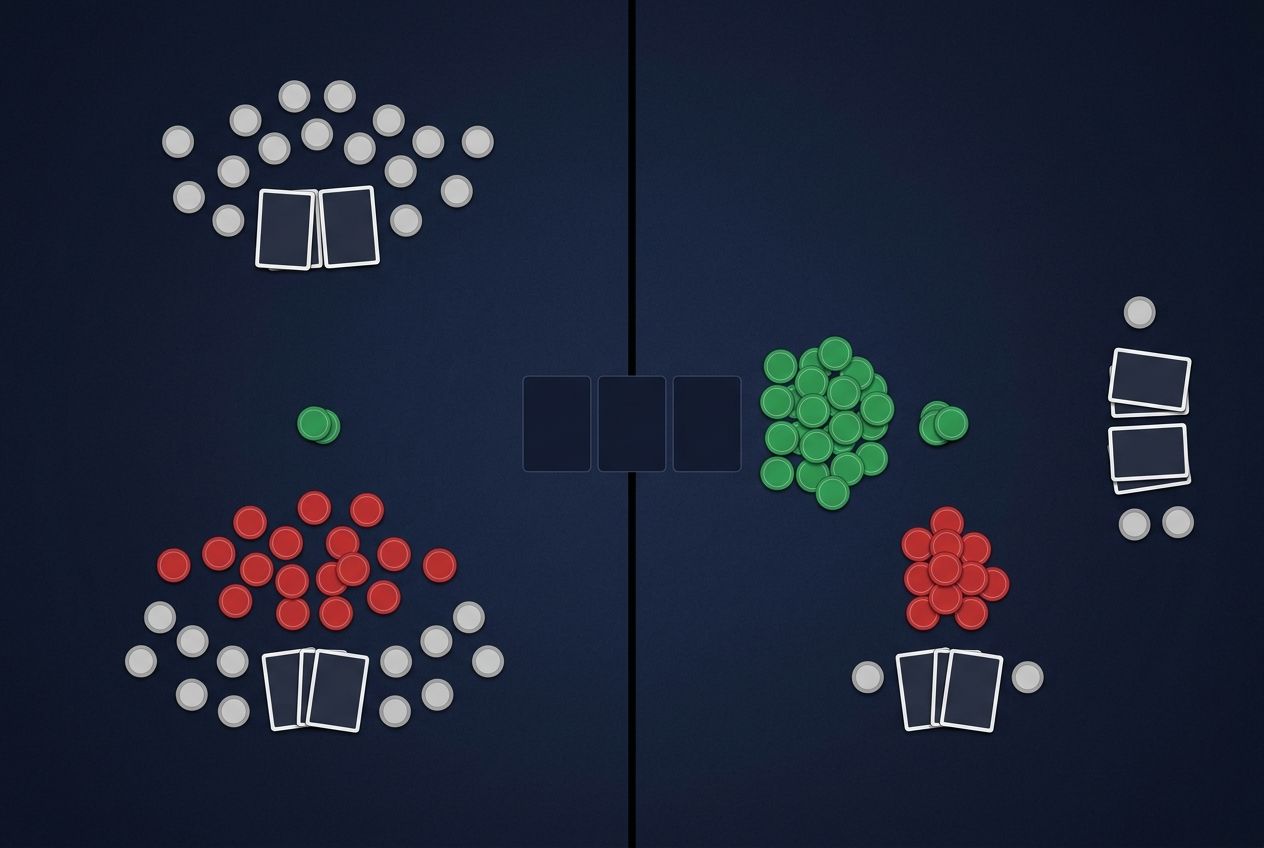
If your opponent bets and you fold too often, their bluffs no longer need to be well chosen. They start making money almost automatically. MDF exists to describe the point where your defense is still strong enough that bluffs do not print by default.
The first and most important intuition is extremely simple.
- Small bets require wider defense.
- Big bets allow narrower defense.
- Defense means continue frequency, not call frequency only.
Why does that matter? A small bet risks little money to pressure your range. If you overfold, your opponent can attack too cheaply. A big bet or overbet puts much more at risk, so you are allowed to continue with a narrower slice of your range and still avoid giving bluffs automatic profit.
If you remember only one idea from this article, let it be this: small sizing means you must stay wider; big sizing means you may stay tighter.
In practice, the direction matters more than the exact percentage
Players often get stuck because they try to treat MDF like a perfect answer key. But in real poker, the most important thing is not whether the exact number is 67% or 64%. The important thing is understanding how your defense should shrink as the bet gets larger.
This is the practical map.
| Opponent sizing | Practical defense feel | What to remember |
|---|---|---|
| 25% pot | Very wide defense | many weak bluff-catchers still survive |
| 50% pot | Still fairly wide | medium bluff-catchers often stay in |
| 75% pot | More selective | pair strength and blockers matter more |
| 100% pot | About half survives | weak bluff-catchers drop out fast |
| 150% pot+ | Quite tight | mostly strong bluff-catchers or strong made hands |
The best way to use this table is not to obsess over exact decimals. Read it as a direction-of-pressure chart. As you move from left to right, the bet gets larger and your defense range gets tighter. That one mental picture already improves many river decisions.
MDF is most useful when you are choosing bluff-catchers on the river
On flop and turn, poker still contains future cards, future barrels, raises, and equity realization. MDF still matters there, but it is only one ingredient. On the river, things get cleaner. No more cards come, and your question becomes much more direct: "Should this hand still belong to my continuing range?"
Suppose your opponent makes a small river bet. If you fold every medium bluff-catcher, you are probably overfolding and letting small bluffs make money too easily. But if your opponent jams for pot or overbets, blindly saying "I must not fold too much because of MDF" can become a disaster if you drag weak bluff-catchers too far.
This is the better question to ask:
For this sizing, is my hand high enough inside my defending range to continue?
That is the real use of MDF. It does not tell you that every bluff-catcher must call. It tells you roughly how wide your overall defense should remain before blockers, unblockers, line credibility, and player tendencies decide which exact combos make the cut.
Three common MDF mistakes
1. Treating MDF like a rigid command
MDF is not a rule that says, "Call exactly this much and you are done." Continue frequency can include raises, and real opponents are rarely bluffing in perfectly balanced ways. MDF is a baseline warning sign against folding too much, not a complete strategy by itself.
2. Defending the wrong hands just to satisfy the percentage
Even if your range should defend wide enough overall, you still need to choose the right hands. Good bluff-catchers block value, unblock bluffs, or hold better showdown properties against the line your opponent took. MDF gives width; hand selection gives accuracy.
3. Using river-style MDF logic too literally on earlier streets
Flop and turn are more dynamic. A hand may continue because of future equity, raising potential, card removal, or future fold equity, not just because it belongs to a static defense quota. MDF helps, but it should not replace broader range interaction thinking before the river.
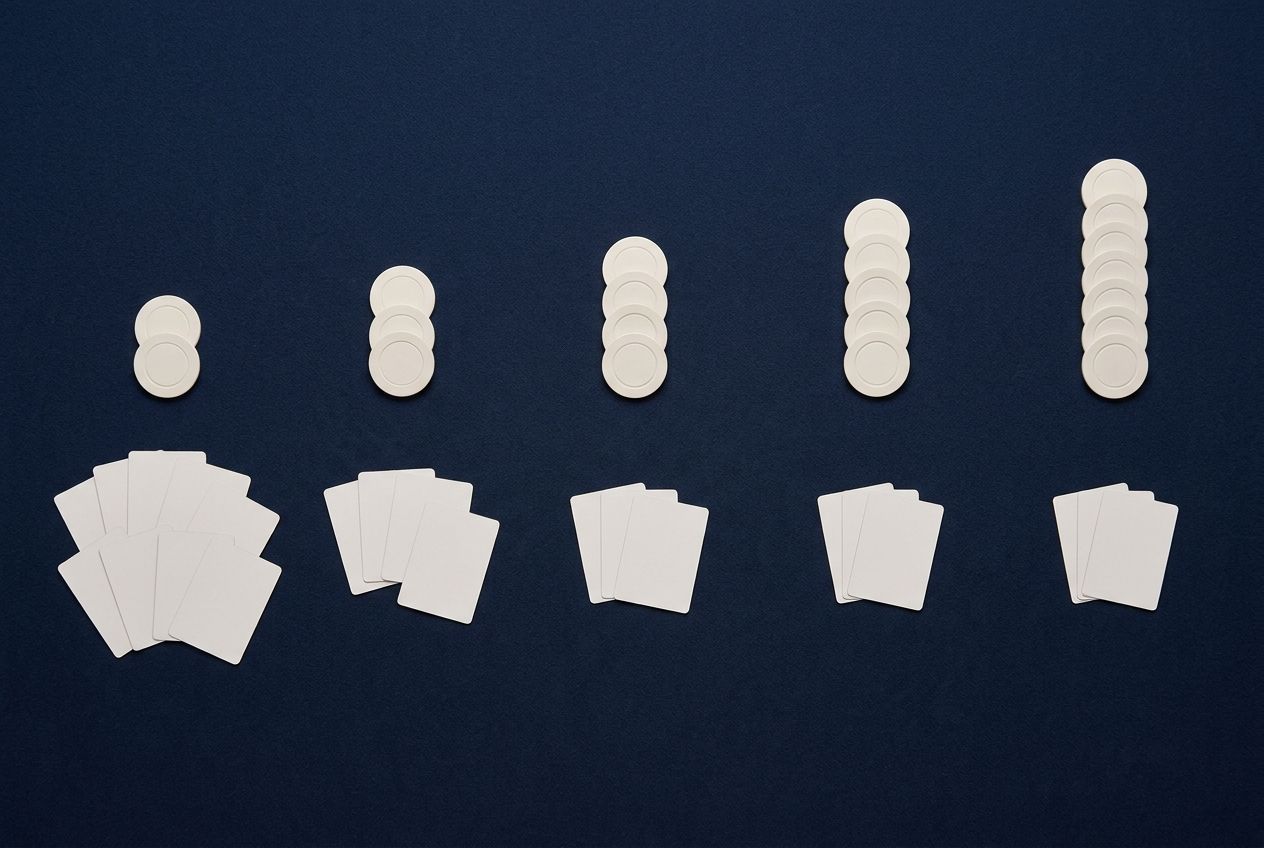
The easiest memory shortcut is the 8-7-6-5-4 ladder
You do not need a perfect chart in your head. For real play, it is enough to remember a simple ladder of shrinking defense.
- Very small bets feel like
8: defend very wide. - Half-pot feels like
7: still defend quite wide. - Around 75% pot feels like
6: noticeably tighter now. - Pot-sized bets feel like
5: roughly half your defense remains. - Overbets feel like
4: defense becomes quite selective.
The true values are only approximate here, but that is the point. The shortcut is meant to create fast decision structure under pressure. It tells you where the pressure lives before your detailed combo selection begins.
For many players, this works far better than trying to recall exact formulas. Once you remember the ladder, your first reaction becomes much healthier. You stop overfolding too hard against small bets, and you stop clinging to weak bluff-catchers against oversized river pressure.
A real-table MDF checklist you can use in seconds
When you face a bet on the river, walk through this sequence.
- Is the size small, medium, large, or huge?
- Does this size require a wide defense or a narrow defense?
- Is my hand near the top, middle, or bottom of that defending range?
- Do my blockers and unblockers help this call?
- Does this opponent actually bluff often enough in this line?
That checklist is where MDF stops being theory trivia and starts becoming decision support. It also protects you from a very common leak: reacting only to the name of your hand while ignoring how much pressure the sizing is actually applying.
Strong players use MDF as structure first, numbers second
Good players usually do not begin with exact percentages in live thought. They begin with structure. They see one-third pot and think, "I cannot fold too much here." They see a pot-sized bet and think, "Now the bottom of my bluff-catchers can drop away." Only after that do they filter by blockers, line quality, and opponent population tendencies.
That is why MDF becomes much more useful when you learn it as a pressure map rather than a chart. The better your sense of sizing and range width, the less you panic in river spots and the more stable your bluff-catching decisions become.
Study
Train MDF decisions inside Study
Continue practicing the MDF definition, size reference points, balanced bluff ratios, and real river bluff-catcher decisions.
Final Summary
MDF is a defense baseline that tells you how your range width should respond to bet size, not a rigid order to call a fixed number of hands.
- The smaller the bet, the wider you should defend.
- MDF sets the width, but blockers and player tendencies choose the exact combos.
- The
8-7-6-5-4ladder is a simple memory shortcut that makes MDF much easier to use under pressure.
Study
Related Study lessons
Related articles
Continue with another angle on the same decision.
MDF, SPR, and Commitment Basics
MDF and SPR are not separate trivia topics. Together they explain how often you defend, how big your hand really is in the pot, and when commitment becomes natural.
Pot Odds, Outs, and Equity With Real Examples
You do not need advanced math to make better calls. You need a fast way to compare price, outs, and realistic improvement chances.
Poker Combos and Blockers Made Simple
Real range reading starts when hands stop being labels and start becoming actual remaining combinations.