Blog
How to Read Poker Cards and Hand Notation
A beginner-friendly guide to card ranks, suits, suited versus offsuit hands, pocket pairs, and common poker hand notation so study content becomes much easier to read.
How to Read Poker Cards and Hand Notation
Poker starts to feel much easier once
A5s,KQo,TT,BTN, andBBstop looking like code and start reading like ordinary language.
One reason hold'em feels confusing at the beginning is that the game introduces too many new words at once. You are not only trying to understand cards and betting. You are also hearing blinds, c-bets, blockers, ranges, overbets, pot odds, GTO, and semi-bluffs in the same conversation.
That is why this guide does not list terms in strict alphabetical order. Instead, it follows the order most players actually learn:
- table structure and hand flow,
- core action words,
- strategy and math words,
- hand-reading and board language,
- review and study language.
You do not need to memorize every term in one sitting. The goal is to make sure the next time you see one of these words in a lesson, a review note, or a table conversation, it feels familiar instead of intimidating.
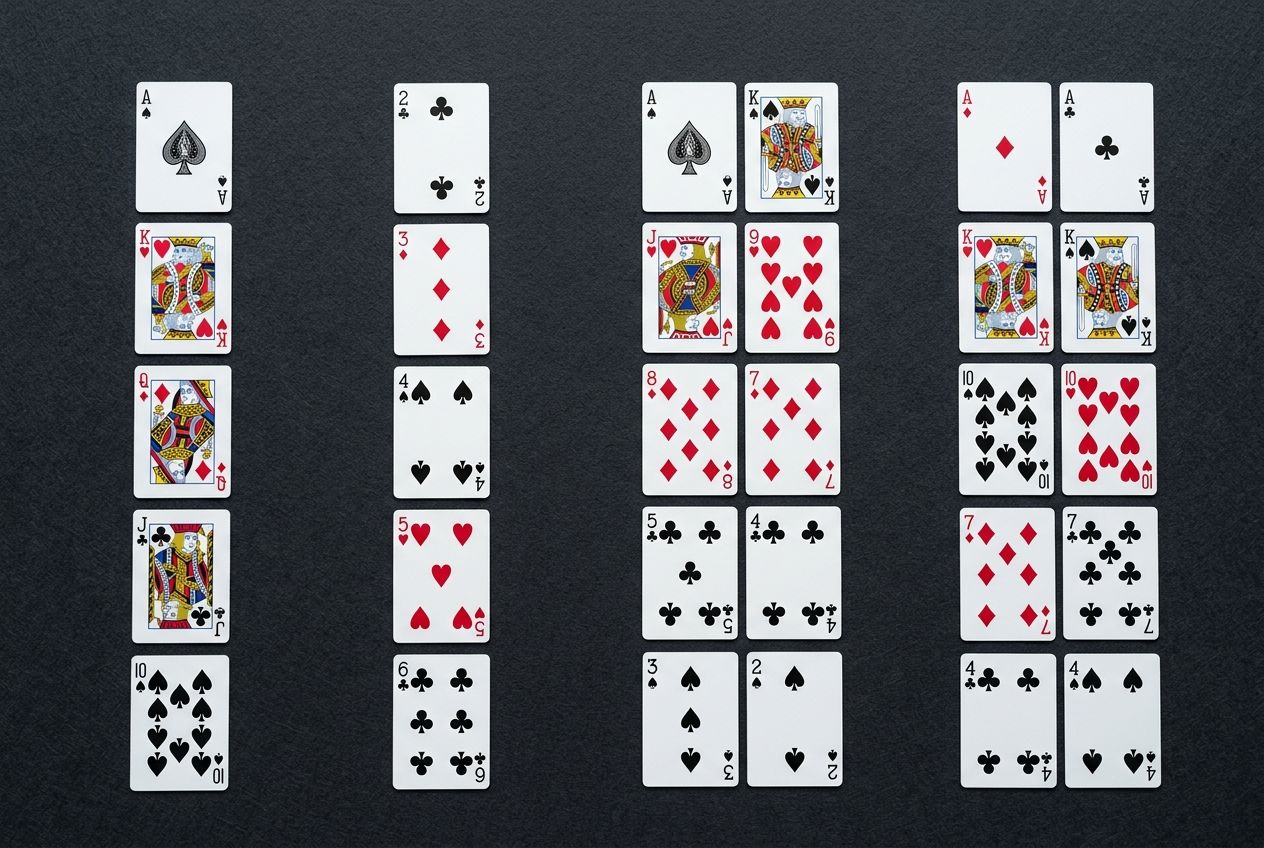
Start by sorting terms into roles
The fastest way to reduce confusion is to group terms by role:
- structure terms
These explain how the hand is organized: blind, preflop, flop, turn, river, position.
- action terms
These explain what players do: check, call, bet, raise, 3-bet, limp.
- analysis terms
These explain why an action may be good or bad: pot odds, equity, range, blocker, EV.
Once you separate terms like that, the language of poker becomes much more manageable.
1. Structure words that explain how a hand works
| Term | Meaning | Beginner note |
|---|---|---|
| Blind | Forced money posted before the cards are dealt | Keeps the game moving and creates a pot before action starts |
| Preflop | The round before the flop appears | Most opening and 3-betting language starts here |
| Flop | The first three community cards | Many continuation bets and texture ideas start here |
| Turn | The fourth community card | Often where second barrels and bigger pressure appear |
| River | The fifth and final community card | The final decision street |
| Showdown | Players reveal their hands to determine the winner | Happens when more than one player survives the river |
| Pot | All the money in the middle | Used for sizing and pot-odds decisions |
| Stack | A player's remaining chips | Usually easier to understand in big-blind terms |
| Position | Your place in the action order | Later action means more information |
| IP | In position | You act after your opponent |
| OOP | Out of position | You act before your opponent |
These words form the skeleton of every hand. If these are unclear, strategy vocabulary becomes much harder to use.
2. Core action words you hear every session
| Term | Meaning | Beginner note |
|---|---|---|
| Fold | Give up the hand | Often the strongest disciplined action |
| Check | Pass without adding money | Only possible if no bet is facing you |
| Call | Match the current bet | A response, not a first attack |
| Bet | Put money in first on that street | Starts the pressure |
| Raise | Increase an existing bet | Escalates the pressure |
| Open | The first raise preflop | Usually the first aggressive action of the hand |
| 3-Bet | A re-raise after an open | A stronger preflop pressure node |
| 4-Bet | A re-raise after a 3-bet | Usually premium value or structured bluff pressure |
| Open limp | Enter by calling instead of raising first in | Common in weak games, less favored in disciplined strategy |
| Check-raise | Check first, then raise a bet | A strong pressure line |
The most important early distinction is simple:
- if nobody has bet yet and you put in money, that is a bet,
- if someone already bet and you increase it, that is a raise.
That sounds basic, but it removes a lot of confusion fast.
3. Hand and card notation terms
| Term | Meaning | Beginner note |
|---|---|---|
| Rank | The card value like A, K, Q, J, T, 9 | T stands for ten |
| Suit | The card symbol or suit | Spades, hearts, diamonds, clubs |
| Suited | Two hole cards of the same suit | Gains flush potential |
| Offsuit | Two hole cards of different suits | Usually weaker than the suited version |
| Connector | Two cards close in rank | Helps make straights |
| Broadway | High cards from ten to ace | Often used in preflop range talk |
| Pocket pair | Two cards of the same rank | Examples: 99, QQ, AA |
| Hand notation | Short form for hole cards | AKs means ace-king suited, KQo means king-queen offsuit |
This is where many beginner study problems disappear. If you can read A5s, KTo, and 76s comfortably, hand reviews and range lessons stop feeling cryptic.
4. Strategy and math words
| Term | Meaning | Beginner note |
|---|---|---|
| Range | The collection of hands a player can have | Modern poker thinks in ranges, not exact hands |
| Equity | Your share of the pot in probability terms | A rough way of saying how often you win or improve |
| Outs | Cards that improve your hand | The start of draw math |
| Pot odds | The price you are getting on a call | Compare required equity with your estimated equity |
| EV | Expected value | Long-run average result of a decision |
| Fold equity | The value gained when opponents fold | Core to bluff and semi-bluff logic |
| Blocker | A card you hold that removes strong combos from villain | Important in bluff selection |
| GTO | Balanced strategy that is hard to exploit | Better treated as a baseline than as a religion |
| Exploit | Adjusting against opponent mistakes | Where most practical profit comes from |
These terms can sound advanced, but each one exists to answer a practical question:
- what can the opponent have,
- how often am I good,
- what price am I getting,
- and how much does my action make over time?
5. Board and postflop interpretation words
| Term | Meaning | Beginner note |
|---|---|---|
| C-bet | Continuation bet by the preflop aggressor | The most common flop aggression pattern |
| Barrel | Betting again on later streets | Turn barrel and river barrel are common phrases |
| Dry board | Board with low connectivity and fewer draws | Often supports smaller betting more often |
| Wet board | Board with many draws or connected cards | Usually needs more caution or stronger value pressure |
| Value bet | A bet targeting worse calls | A core money-making concept |
| Bluff | A bet targeting folds from better hands | Needs fold equity to work |
| Semi-bluff | A bluff with draw equity | Can win now or improve later |
| Showdown value | A hand that can often win without betting big | Not every medium hand should bluff |
| Thin value | Betting a hand that is only slightly ahead | Stronger concept once you understand target call ranges |
These are the terms that make poker strategy sound sophisticated. But once the structure and action words are clear, these become much easier to place.
6. Review and study words
As you study more, you will also hear terms used in reviews and learning tools:
- mark hand: a hand saved for later review
- node: a specific decision point in a tree
- playbook: a short rule for recurring situations
- pool tendency: a repeated population behavior
- solver: a tool that computes equilibrium-based strategy suggestions
These words matter because improvement depends on more than playing. You also need to name what happened so you can review it properly.
The most important beginner principle
You do not need to master all poker language at once. You only need the next layer of vocabulary that helps the next decision make sense.
That means:
- first learn structure words,
- then action words,
- then notation,
- then range and math terms,
- then deeper postflop and review terms.
That learning order is much more effective than trying to memorize everything randomly.
Study
Practice card notation and hand reading in Study
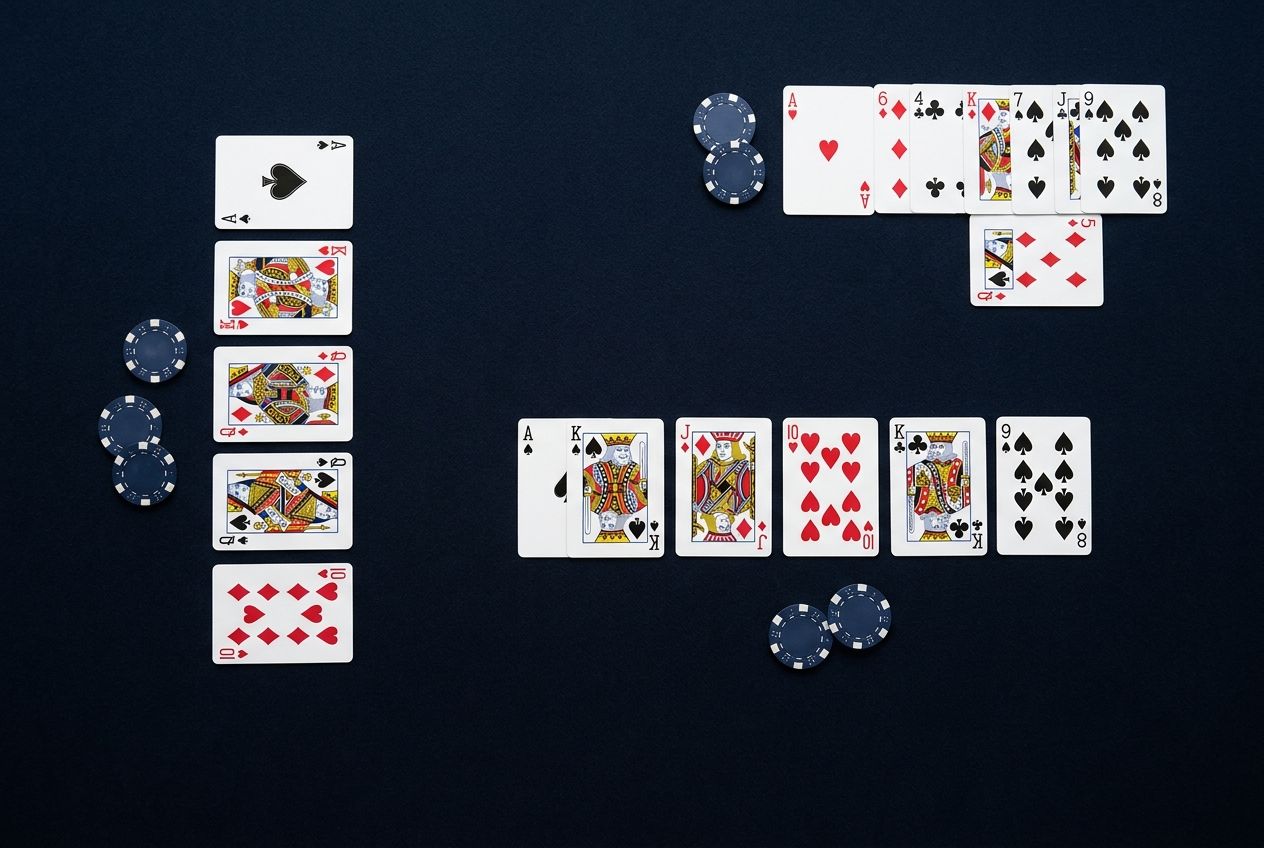
Train suited versus offsuit, rank and suit notation, and basic hand-reading vocabulary through repeated study scenes and quizzes.
Final Summary
Poker language becomes manageable once you stop treating it like one giant glossary and start seeing it as layers of the same game.
Keep these three action rules:
- Learn structure, action, and analysis terms in that order.
- Get comfortable with hand notation early because it unlocks every later lesson.
- Use new terms only when they help explain a real decision, not as pure vocabulary drills.
Once the language is clear, the strategy becomes much easier to absorb.
Study
Related Study lessons
Related articles
Continue with another angle on the same decision.
How a Hold'em Hand Flows at the Table
A hand becomes much easier once you can instantly spot the button, the blinds, and who acts first on each street.
Check, Call, Bet, and Raise Explained Simply
Poker actions become much easier when you separate actions that start pressure from actions that answer pressure.
Showdown, Kickers, and Best Five Cards
Knowing hand rankings is not enough. You also need to know when showdown happens, how the best five cards are built, and when kickers actually decide the winner.