Blog
EP Open Discipline and LP Expansion Playbook
An advanced preflop guide explaining the structural difference between EP and LP opens, including dominated offsuit broadways, suited connectors, offsuit broadways, and position-driven range expansion.
The same open raise means different things in UTG and BTN
Good preflop opening is not about whether a hand looks decent. It is about how well that hand survives calls and 3-bets with players still left behind.
One of the biggest preflop leaks comes from treating hand strength as fixed. Players see a hand like KTo or ATs and ask only whether it looks playable. In reality, 6-max poker does not reward that kind of static thinking. The same hand changes value dramatically as position changes.
That is the practical split. Early position is about discipline: cutting out hands that look playable but become dominated too often. Late position is about controlled expansion: adding hands that gain EV through steal pressure and positional realization.
This article turns that idea into a practical playbook:
- why early position removes dominated offsuit broadways,
- why middle position expands only one layer and not infinitely,
- why CO and BTN can profitably include suited connectors and wider offsuit broadways,
- and how to reduce all of that into short repeatable rules.
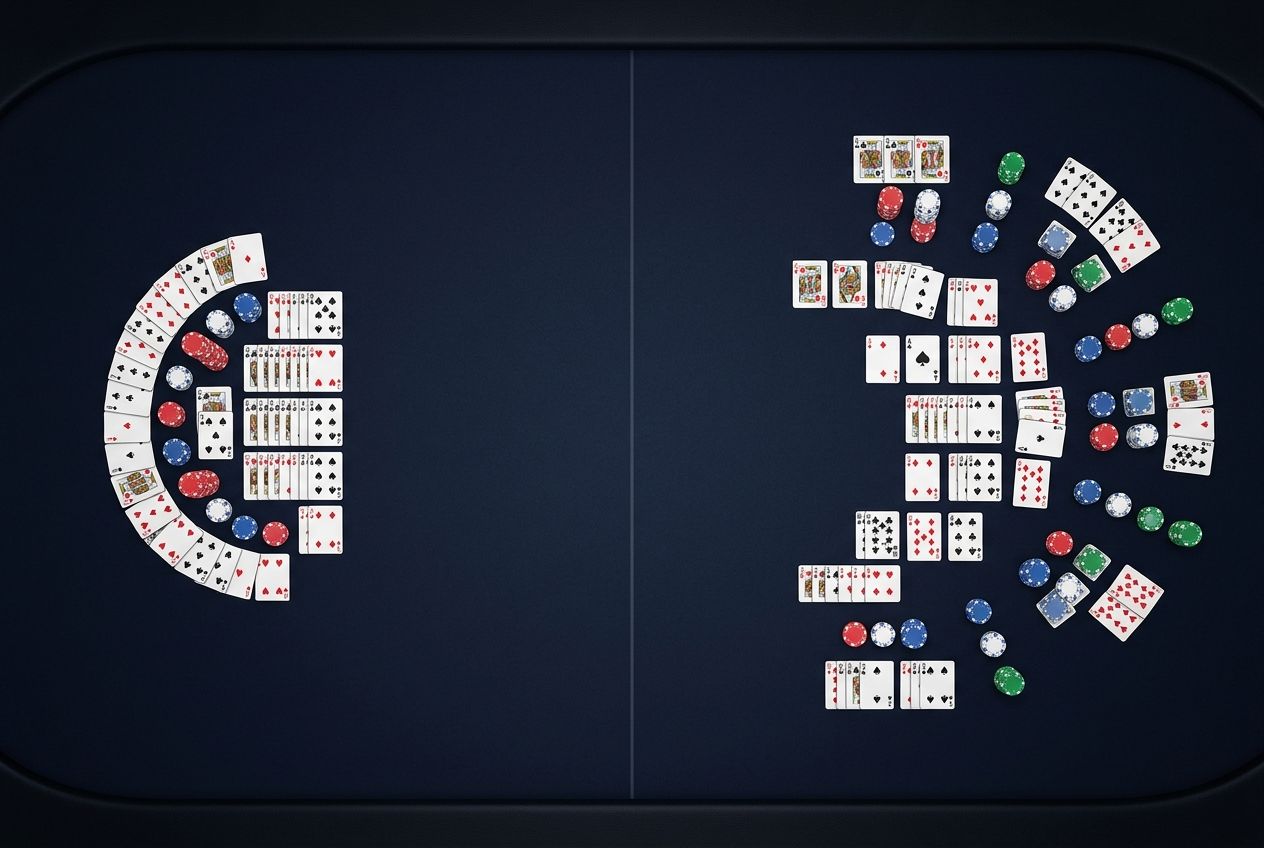
In early position, discipline means folding hands that merely look acceptable
The core of EP strategy is not finding hands that seem playable. It is removing hands that become expensive when called or re-raised.
UTG is the tightest open position in 6-max because five players remain behind. That means two bad things happen more often:
- your open gets attacked by stronger ranges,
- and when you do get called, you often enter postflop with domination risk.
That is why hands like KTo, QJo, and JTo shrink in value so fast in UTG. They look like broadways, but they make second-best top pairs too often, create awkward OOP pots, and struggle against tighter calling and 3-betting ranges.
By contrast, stronger pocket pairs and sturdier suited broadways survive much better. 99, AQs, and ATs are not just stronger on paper. They are structurally stronger once the open is challenged.
So an EP playbook starts with rules like these:
UTG: remove dominated offsuit broadways firstUTG and MP: build from strong pairs and quality suited broadwaysMP expands one layer, but keeps the same discipline
Late position expansion is not looseness. It is positional conversion of EV
CO and BTN widen not because everything becomes good, but because position and steal pressure make more hands profitable.
Once you move to CO and BTN, two things change:
- fewer players remain to act,
- and postflop position becomes a massive source of EV.
That is why 86s can become a profitable CO open even though it is too loose for UTG. Suited connectors gain value because they realize better in position, make disguised strong hands, and also win many pots preflop through fold equity.
The same is true for hands like K9o on the button. Their raw hand strength is still modest, but the steal value and positional advantage make them natural opens.
But controlled expansion still has a boundary. J4o in CO is not suddenly a good hand just because the seat is looser. It remains offsuit, disconnected, easily dominated, and poor at realizing EV.
That gives us the LP playbook:
| Position | Default playbook rule |
|---|---|
| CO | Expand into suited connectors and practical suited hands |
| BTN | Expand farther into offsuit broadways and weaker suited hands |
| CO and BTN | Do not confuse expansion with opening trash offsuit hands |
Strong open strategy is built on reasons, not on habit
The best preflop players can explain why a hand earns money from that seat instead of memorizing that it appears in a chart.
For example, opening ATs in MP should be explainable:
- fewer players remain than in UTG,
- suited ace structure improves domination resistance,
- the hand realizes well through top pair potential and nut-draw potential.
Folding J4o in CO should also be explainable:
- offsuit hands realize poorly,
- the hand is dominated too often,
- it lacks connectivity and nut potential,
- and late position is still not a license to open anything.
Once those reasons are clear, your baseline stays intact even without a chart in front of you.
The most common leak is treating EP like LP, or LP like EP
Players rarely fail because they know nothing. They fail because they underestimate how much position re-prices the same hand.
The expensive mistakes are familiar:
- opening too many dominated broadways from UTG,
- refusing to widen naturally from CO and BTN,
- turning LP expansion into random looseness,
- or using the same open rules across every seat.
Those are all versions of the same leak: pretending hand value is static when it is actually positional.
The best way to carry this into a real session is through short rules
Long theory notes are fine for study, but not for action. What you need during a session is something like this:
EP: cut dominated offsuit broadways firstMP: widen slightly, but keep structureCO: add suited connectors and more suited utilityBTN: add more offsuit broadways and weak suited stealsLP is wider, not random
Study
Practice EP discipline and LP expansion in Study
Train which hands to remove in UTG and MP, and which hands to expand in CO and BTN, through repeated position-based preflop scenes.
Final Summary
The difference between EP and LP is not just a longer chart. It is a different reason why the hand earns money.
Keep these three action rules:
- In EP, remove domination risk before you chase visible hand strength.
- In LP, use position and steal EV to widen in a structured way.
- Wide late-position opening is still disciplined; trash offsuit hands remain trash.
Once that framework becomes automatic, preflop opening stops being guesswork and starts looking like a real positional system.
Study
Related Study lessons
Related articles
Continue with another angle on the same decision.
Starting Hands, Open Raises, and Why Limping Causes Problems
A starting hand is only “good” inside a seat, stack, and plan. Once you understand that, open raising becomes a much cleaner default.
Thinking in Ranges for Beginners
Poker gets clearer when you stop guessing one exact combo and start comparing whole groups of hands that can still exist.
3-Bet and 4-Bet Response Basics
Treat 3-bet pots as structured range clashes, not emotional ego battles. Once you sort hands into response buckets, preflop becomes much cleaner.