Blog
Dry Board C-Bet Playbook
An advanced postflop guide explaining when dry boards support small high-frequency c-bets, when they require more selective betting, and how to carry the plan onto the turn.
A dry board does not mean "bet often." It means you should be able to explain why frequent small betting makes sense
A strong dry-board c-bet is not "I was the preflop raiser, so I bet." It is "this range structure naturally supports a small size at high frequency."
Many players learn one helpful but incomplete shortcut: dry boards are good c-bet boards. That idea is fine at the start, but it becomes too blunt once you try to build a real postflop system. A♣ 7♦ 2♠, K♥ 8♣ 3♦, and Q♠ 7♣ 5♦ may all look dry, but they do not produce the same betting tree.
The real question is not whether the board is dry in a visual sense. The real question is whether the preflop raiser can represent enough top-end strength, force enough folds with a small size, and still preserve a healthy checking range for later streets.
That is what this article is about. We are taking the vague idea of "dry boards are good for c-betting" and turning it into a repeatable playbook:
- which dry boards are true small-high-frequency nodes,
- which ones require more hand selection,
- which hands should remain in the checking range,
- and which turn cards let the story continue naturally.
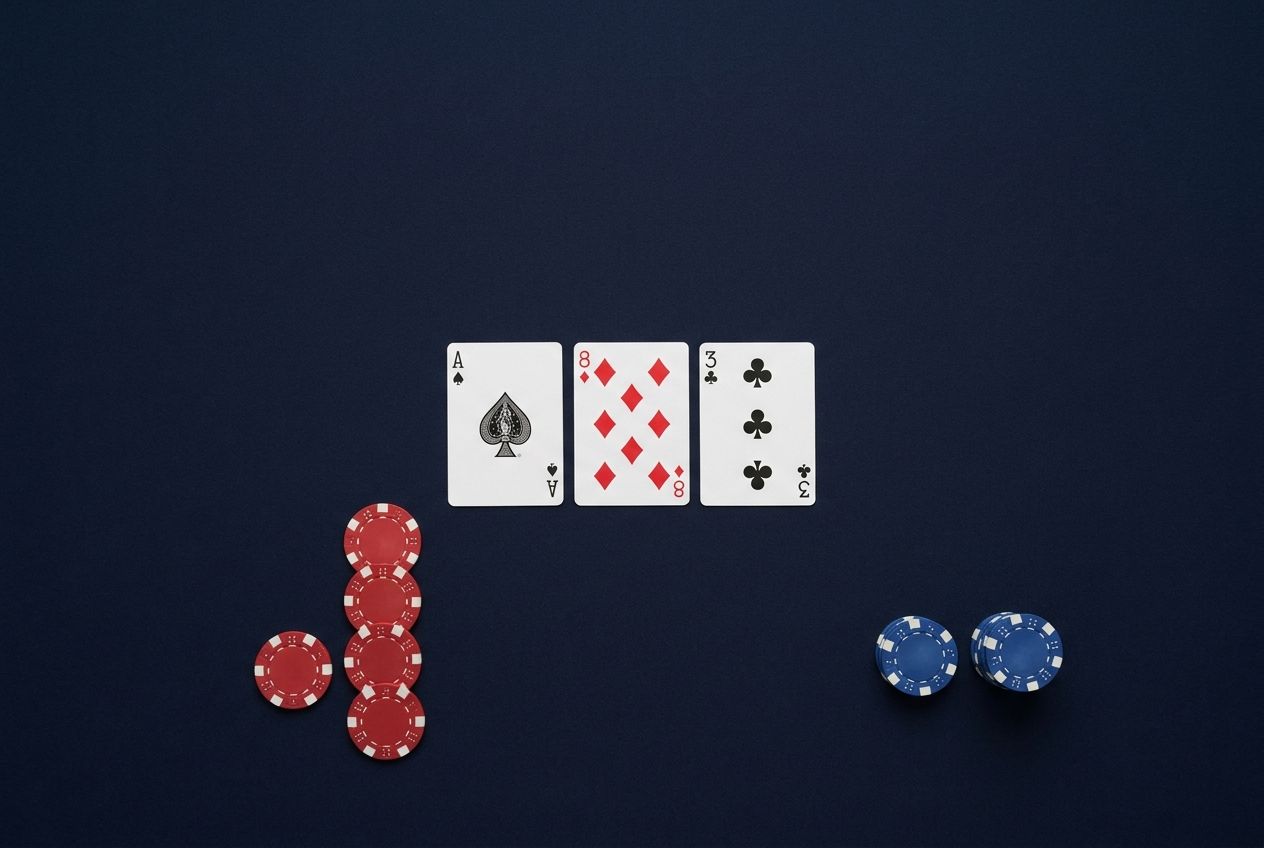
Start with the right definition: dry boards are not boards the defender misses, but boards where strong continue is harder
The important feature of a dry board is not that the defender has nothing. It is that the defender has fewer strong raises, fewer robust draws, and fewer comfortable continues.
Take A♣ 7♦ 2♠. The preflop raiser still carries a lot of Ax, strong broadway ace-high, and overpairs. The defender can certainly have some Ax, sets, and a few pair-plus-backdoor structures, but the overall distribution favors the raiser. That makes a small c-bet attractive because the defender is not equipped to continue aggressively across a wide set of hands.
But that logic cannot simply be copied onto every dry-looking board. Once the highest card drops from ace to king or queen, the interaction changes. The defender's middle-pair continues become more comfortable, the raiser's top-end edge shrinks, and some automatic betting disappears.
So at an advanced level, "dry" is just the headline. The real work is deciding which dry boards truly belong to the same betting family.
A-high, K-high, and Q-high dry boards need different default rules
If you want a practical playbook, split dry boards into at least these groups:
| Board family | Default playbook line | Why it works |
|---|---|---|
| A-high dry | Small size, high frequency | The raiser keeps a strong top-end edge and the defender has fewer robust continues |
| K-high dry | Small size still works, but check-back protection matters more | The defender's Kx and middle-pair continues are more natural |
| Q-high dry | Do not treat as automatic high frequency | The defender interacts more comfortably and the raiser's advantage is less clean |
This is where many good regulars separate themselves from "looks dry, therefore bet" thinking.
On A-high dry textures, the raiser often owns the clearest story. Top pair advantage is obvious, strong value remains dense enough, and even some air can function because the board still strongly belongs to the raiser.
On K-high dry boards, betting small is still often correct, but the node is less automatic. The defender reaches flop with more natural king-x continues and more middle-pair structures that do not hate one small bet.
On Q-high dry boards, the difference becomes even more important. The board still looks simple, but the interaction is not as one-sided. If you fire at very high frequency just because the board is rainbow and disconnected, you often end up over-bluffing a node that was not truly automatic in the first place.
Advanced players define their checking range before they define their betting frequency
Good frequency design is not only about what you bet. It is also about what you intentionally keep in the checking range so the tree stays healthy on later streets.
This is one of the biggest differences between intermediate and advanced postflop play. Intermediate players focus on the betting range. Advanced players also protect the checking range.
Why does that matter on dry boards?
- You do not want your check-back line to collapse into obvious weakness.
- You want to preserve some hands that can realize showdown value without bloating the pot.
- You want to avoid turning every no-backdoor air hand into a low-quality automatic bluff.
On K-high dry or Q-high dry boards, for example, some medium-strength showdown hands often perform better as checks than as mandatory bets. Those checks preserve stability, protect future defense, and stop your flop strategy from becoming mechanically overaggressive.
The same logic applies to the bottom of the range. Not every hand with zero showdown value deserves to stab. If the hand lacks overcards, lacks meaningful backdoors, and lacks a good turn plan, checking it can be more disciplined than forcing a c-bet just because the board looks quiet.
Turn planning is where the playbook becomes real
The flop c-bet is only the first sentence. The real question is whether the turn card lets that sentence continue naturally.
Many players memorize the flop rule and forget to build the turn plan. Then they c-bet well on the flop and lose structure on the turn.
In practice, good turn cards on dry-board trees usually do one of three things:
- strengthen the raiser's top-end story,
- pressure the defender's medium continues,
- or improve the bluff candidate through added equity or a stronger blocker story.
Bad turn cards do the opposite. They strengthen the defender's continue range, remove pressure from your flop bluffing line, or fail to give your range a believable next step.
That means a real playbook should never end at "small c-bet often." It should also include at least one follow-up rule:
| Turn card type | Practical default |
|---|---|
| Favorable overcard for the raiser | Increase barrel frequency |
| Card improving defender middle-pair or sticky continue | Slow down and reclassify |
| Card adding real backdoor equity to bluff candidates | Selective second barrel |
| Blank that changes little | Re-sort hands by value, showdown value, and bluff quality |
The expensive mistakes on dry boards are usually structural, not emotional
Players rarely lose the most money on dry boards because they are scared. They lose because they apply the right headline to the wrong node.
Common expensive mistakes:
- Using oversized bets on A-high dry boards
A small size already does the job. Betting too big often isolates yourself against stronger continues.
- Treating Q-high dry like A-high dry
The label "dry" hides a real difference in range interaction.
- Betting every medium-strength showdown hand
This leaves the checking range too weak and creates awkward turn defense.
- Memorizing flop frequency without a turn plan
A good flop c-bet becomes a messy turn decision if there was no continuation map.
The real goal is to compress complexity into short reusable rules
Advanced strategy is not useful if it lives only in long theory notes. It becomes powerful when it can be reduced to short, repeatable rules.
For this topic, the rules can be as simple as:
A-high dry: small-high frequency defaultK-high dry: small size works, but preserve check-back protectionQ-high dry: do not treat as an auto-bet familyPlan the turn before you press the flop c-bet button
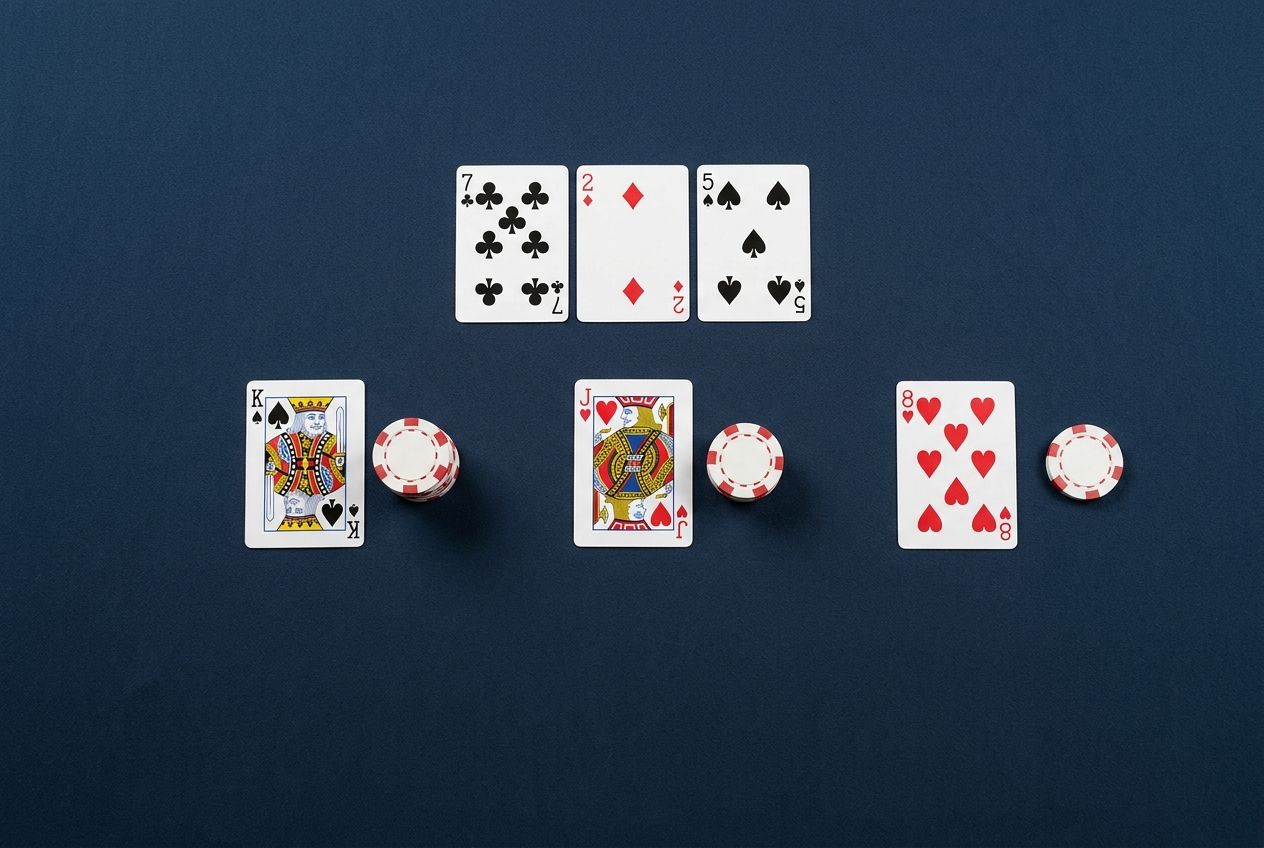
Study
Practice dry-board frequency playbooks in Study
Compare A-high, K-high, and Q-high dry boards and train when small-high frequency is natural and when check-back protection matters more.
Final Summary
The point of dry-board strategy is not to bet more often. The point is to know when the node truly deserves automation and when it needs restraint.
Keep these three action rules:
- Do not lump all dry boards into one bucket. Split A-high, K-high, and Q-high families.
- Even in high-frequency nodes, keep a protected checking range.
- Build the turn-barrel map before you rely on flop frequency.
Once those rules become automatic, dry boards stop being vague "easy c-bet spots" and become repeatable, profitable playbook nodes.
Study
Related Study lessons
Related articles
Continue with another angle on the same decision.
Wet Board and Turn Barrel Playbook
Connected wet boards are not flop-only decisions. This guide shows when to slow down, when to bet bigger, and which turn cards truly unlock strong second barrels.
Board Texture, C-Bets, and Simple Barrel Rules
Dry boards and wet boards are not just visual labels. They change how often you can bet, how large you should size, and whether your turn plan still makes sense.
Range Advantage and Nut Advantage Explained
Who connects with the board more often is not always the same as who holds the strongest possible hands more often. You need both ideas to understand flop strategy.