Blog
Board Texture, C-Bets, and Simple Barrel Rules
Learn how board texture changes c-bet frequency, bet sizing, and turn barreling decisions in a more practical, detailed way.
The board decides whether your c-bet is credible
Not every flop gives the preflop raiser the same right to apply pressure. Good c-bets come from structure, not habit.
Many players first learn the idea that the preflop raiser should c-bet often. That sentence is directionally useful, but it becomes dangerous when it turns into autopilot. In real games, the board does not treat every preflop aggressor equally. Some flops allow wide, efficient pressure. Others punish lazy continuation bets immediately.
That is why board texture matters so much. It is not just a vocabulary label like "dry" or "wet." It is a quick way to estimate:
- which range connects more naturally,
- which player has more strong made hands and durable draws,
- whether a small bet can achieve enough pressure,
- and whether your turn plan will still make sense if called.
Dry boards are not "boards people miss." They are boards people struggle to continue strongly on
A dry board is not just a board the defender misses. It is more often a board where strong and natural continuations are limited.
Beginners often describe a dry board as one opponents "do not hit." That is close, but not precise enough. A better description is this: a dry board does not give the defender many strong and natural continuations.
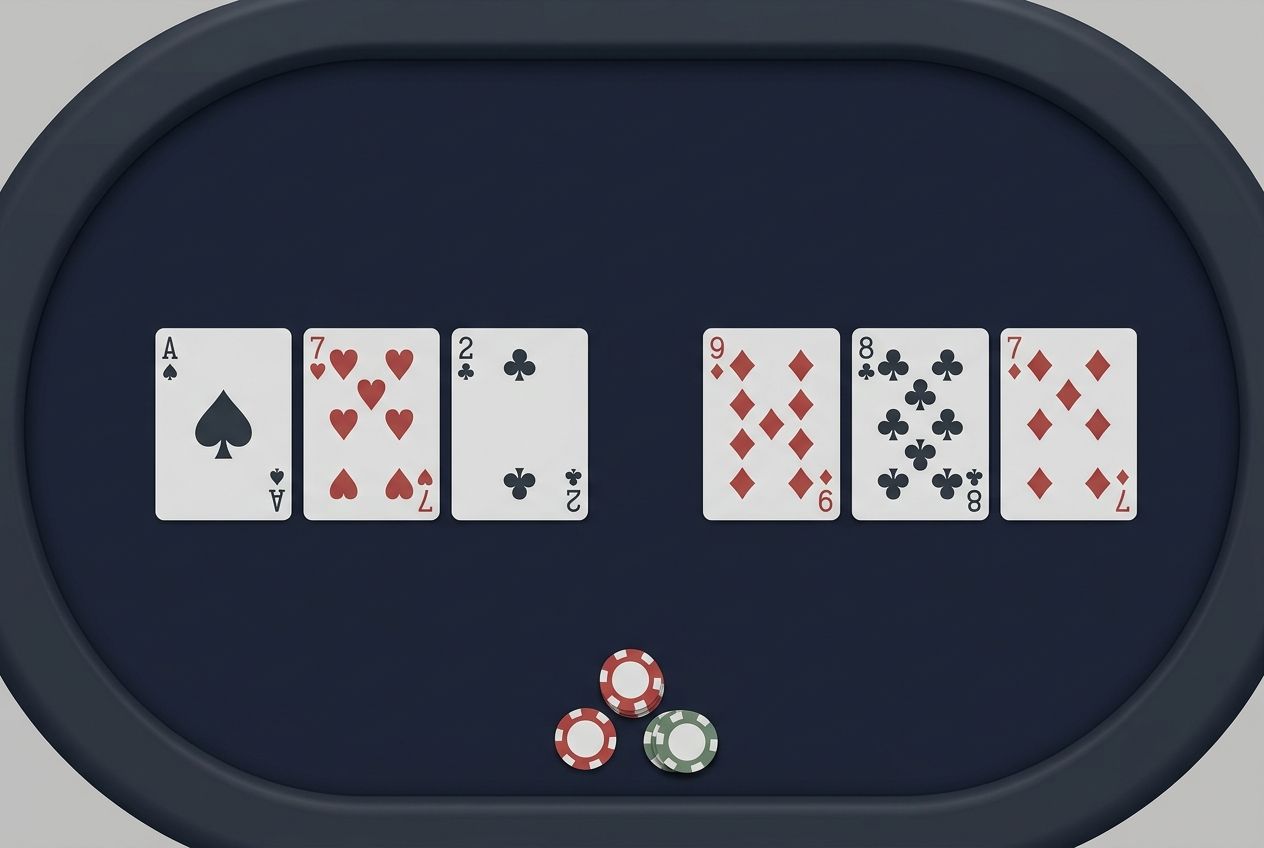
Take a board like A♣ 7♦ 2♠.
On that structure:
- the defender may still have some weak pairs, backdoors, and a few sticky floats,
- but there are not many immediate strong draws or two-pair-heavy combinations,
- while the preflop raiser still carries plenty of
Ax, overpairs, and high-card hands that interact naturally with an ace-high board.
Because of that, a small c-bet often works well. It pressures a wide slice of the defending range, it keeps the aggressor's full range flexible, and it does not force the bettor to overcommit on a board where many folds are already available.
The important point is not "dry means always bet." The important point is that small, frequent pressure often fits the structure of the board.
Wet boards are difficult because the interaction keeps going
Wet boards become difficult when both ranges can keep fighting on future streets, not just because a draw exists.
Now compare that to a flop like 9♠ 8♠ 7♦.
This board is hard for the aggressor not simply because it contains draws, but because so many practical turn-and-river paths stay alive:
- pair-plus-draw hands continue comfortably,
- strong combo draws can raise,
- medium made hands can call and improve,
- and many turn cards change the pressure dynamics for both players.
That makes a huge difference. On a wet board, the defender does not just "have something" more often. The defender keeps hands that can continue aggressively or profitably across multiple streets.
That is why automatic small c-bets become expensive here. You are no longer buying folds from a weak and capped range. You are often offering a good price to a range that can fight back, improve, and put you in awkward turn spots.
Texture changes sizing, not only betting frequency
One of the biggest beginner mistakes is treating texture as a frequency question only. In practice, it is also a sizing question.
On many dry boards:
- smaller bets can still generate enough fold equity,
- your range can bet more broadly,
- and you keep your turn options open when called.
On many wet boards:
- very small bets may not pressure enough of the continue range,
- your value and semi-bluff candidates need to be chosen more carefully,
- and checks become more important for protecting the overall range.
That does not mean every wet board needs a large bet, or every dry board needs a small one. It means the board should influence the story your size is trying to tell.
A practical beginner framework
| Board type | Useful default instinct |
|---|---|
| A-high, K-high, rainbow, low connectivity | Bet more often, smaller sizes can work |
| Connected, two-tone, middle-card heavy | Slow down, check more, choose better candidates |
| Boards that fit the caller's continue range strongly | Avoid lazy automatic c-bets |
This table is not a solved chart. It is a thinking shortcut. Your first job is not memorizing one perfect frequency. Your first job is understanding why the board invites or punishes wide pressure.
The turn matters more than the flop c-bet itself
The real question is not whether you can bet the flop once. It is whether the turn still lets your story make sense after a call.
In practice, many players do not lose most of their EV on the flop. They lose it on the turn, after making a thoughtless flop c-bet with no plan for what comes next.
A good second barrel usually becomes more attractive when the turn:
- strengthens the bettor's value region,
- weakens the caller's medium-strength continues,
- or improves the bettor's semi-bluff equity at the same time.
That is the key habit: do not ask only whether this flop is a c-bet spot. Ask whether the likely turn cards will let your story continue naturally.
On a dry ace-high flop, a broadway turn may strengthen the aggressor's narrative. On a wet connected flop, a turn that completes or reinforces the caller's robust continues may make the second barrel far less attractive.
The five-question checklist before you c-bet
Before you bet the flop, run through these questions quickly:
- Which range connects better with this board?
- How many strong draws and raise candidates does the defender keep?
- Does a small bet actually accomplish enough?
- Are there enough good turn cards to continue the pressure later?
- Can I explain this c-bet with something stronger than "I raised preflop"?
If three or more of those answers feel shaky, checking is often better than forcing a weak c-bet.
Three expensive beginner leaks
- Using oversized bets on clean dry boards
You often fold out the weakest hands anyway and isolate yourself against stronger continues.
- Using tiny auto-c-bets on wet boards
This can allow the defender to continue too comfortably with hands that play well on many turns.
- Repeating the flop plan on every turn
"I already bet once, so I should keep going" is not a strategy. It is momentum bias.
Study
Practice board-based postflop plans
Use Study to compare dry boards, wet boards, and the turn cards that support or weaken a second barrel.
Texture study should lead to better turn decisions
The goal is not to name flops correctly. The goal is to recognize when pressure stays efficient and when the board starts pushing back.
The goal is not becoming good at naming flops. The goal is learning to recognize when your range can apply pressure efficiently, when the defender has too many durable continues, and when the turn still supports the line you started on the flop.
That is why this topic improves so much when you study it through repeated scenes. A dry ace-high board is not identical to every other ace-high board. A wet board with straight pressure is not the same as a board with mostly flush pressure. The details matter, and they matter most when you decide whether to keep barreling or slow down.
In Study, you can compare those textures one scene at a time and build the habit of asking the right questions in the right order. Once that habit forms, postflop stops feeling like random aggression and starts feeling like structured pressure.
Study
Related Study lessons
Related articles
Continue with another angle on the same decision.
Dry Board C-Bet Playbook
A-high, K-high, and Q-high dry boards are not the same auto-bet node. This guide turns range advantage, nut advantage, and check-back protection into a practical postflop playbook.
Wet Board and Turn Barrel Playbook
Connected wet boards are not flop-only decisions. This guide shows when to slow down, when to bet bigger, and which turn cards truly unlock strong second barrels.
Range Advantage and Nut Advantage Explained
Who connects with the board more often is not always the same as who holds the strongest possible hands more often. You need both ideas to understand flop strategy.