Blog
Blind Defense and Resteal Adjustments
An advanced blind strategy guide covering BB price-based defense, SB structural discomfort, BTN steal responses, and when blocker-driven resteals are preferable to passive flats.
The blinds are not one defensive zone. BB defends with price, while SB often needs to fight back structurally
Treating SB and BB as one generic blind strategy is one of the fastest ways to leak preflop EV.
Players often summarize blind play with one sentence: defend wider from the blinds. That sentence is not wrong, but it is incomplete enough to be dangerous. The big blind and small blind do not defend under the same conditions.
The BB has already posted a full big blind, closes the action more often, and frequently receives excellent price. The SB is out of position by default, often leaves the BB behind when flatting, and suffers far more from passive defense.
That is why blind defense and resteal spots should be split into clear roles:
- BB protects range through price and realization,
- SB often prefers aggression over passive flats,
- and BTN steal responses need separate playbooks for each blind.
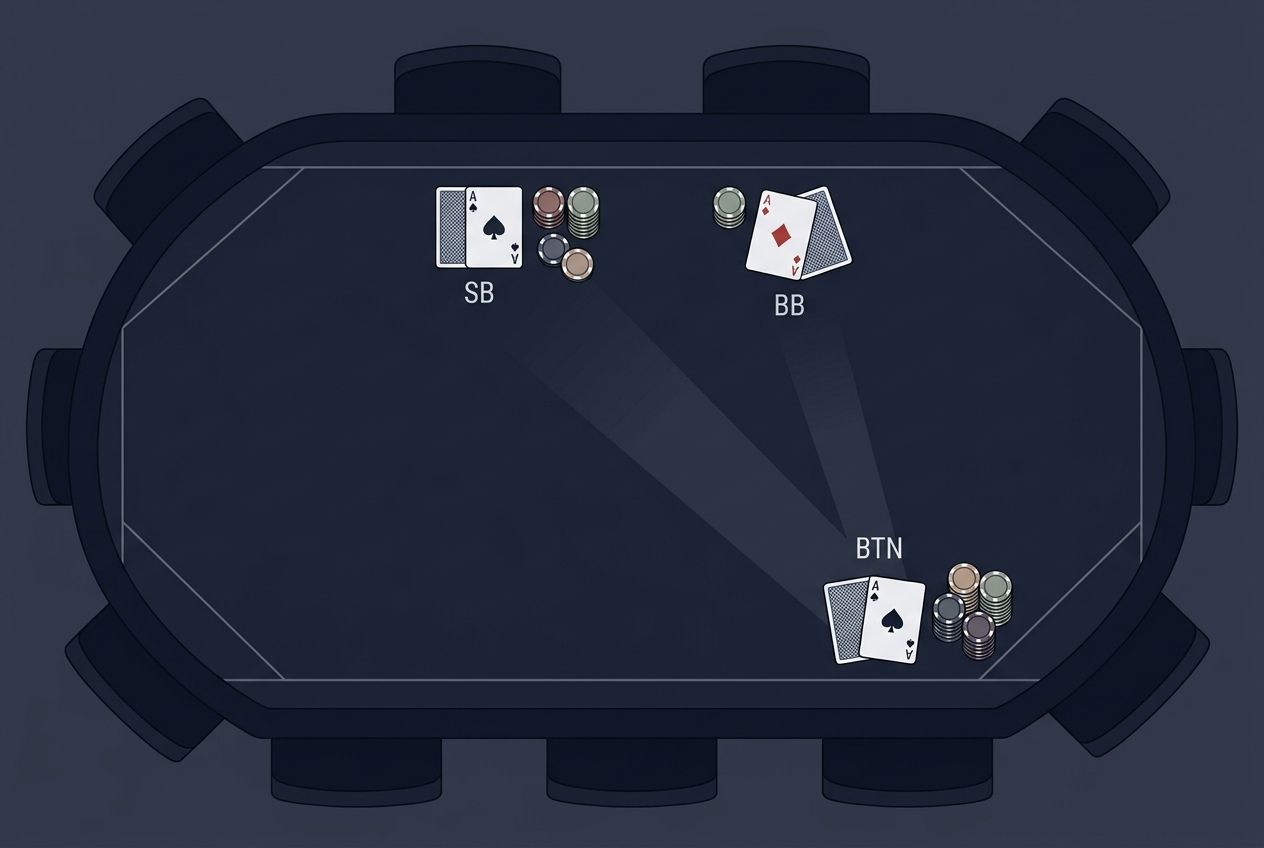
BB defense is built around price and practical realization
The BB is not supposed to defend only "strong hands." It is supposed to defend the hands that become profitable once price and range width are considered together.
Hands like T7s, K9o, or 97s can all become natural BB defenses against late-position opens. That does not mean they are powerful in isolation. It means:
- the opener is wide enough,
- the BB already invested 1BB,
- the open size is often small,
- and the hand keeps enough realization through suitedness, connectivity, or top-pair potential.
That leads to the first BB rules:
Do not overfold suited hands and decent offsuit broadways against small CO or BTN opensHands with realization value but weak blocker value often prefer calling over 3-bettingAlways evaluate price together with the opener's range width
SB defense is structurally more uncomfortable, so aggression matters more
Flatting in the small blind is not just out of position. It also leaves the BB behind and creates one of the least comfortable passive structures in 6-max.
This is why A5s becomes such a natural SB 3-bet candidate against a BTN open. It has:
- a strong ace blocker,
- enough postflop playability if called,
- and a structure that suffers when it just flats OOP.
That is the key distinction. In BB, the same hand classes can often defend by calling because the price is attractive. In SB, the structural discomfort pushes many borderline flats toward either aggression or folding.
BTN steal defense should be split into two different systems
You are not defending "against a BTN open." You are defending as a specific blind with its own structural incentives.
That means the same BTN steal should trigger different defaults:
| Seat | Practical default |
|---|---|
| BB | Wider price-based call defense |
| SB | More 3-bet or fold structure |
| Both | Increase total defense when BTN steals too wide, but use seat-specific mechanics |
So K9o calling in BB and A5s 3-betting in SB can both be correct against the same steal range. The difference is not hand pride. It is structural geometry.
Resteals are not emotional counterpunches. They are designed pressure tools
A good resteal uses wide steal frequency, blocker leverage, and the discomfort of flatting from the small blind all at once.
If BTN steals too wide, SB loses EV by only calling passively. But that does not mean every suited hand becomes a 3-bet. Good resteal candidates usually offer at least some combination of:
- strong blockers,
- clean aggression EV,
- reduced desire to flat OOP,
- and enough playability if called.
That is why A5s is such a classic candidate, while some suited connectors remain better realization hands than aggressive blockers.
The expensive blind mistakes usually come from mixing BB logic and SB logic
Most players do not fail because they are too passive or too aggressive overall. They fail because they apply the same defense logic to two seats with different structural rules.
Common leaks:
- overfolding the BB when price is excellent,
- flatting too often in the SB,
- defending BTN steals with the same pattern from both blinds,
- overusing weak-blocker hands as resteals.
These are all versions of one deeper mistake: collapsing SB and BB into a single blind category.
The real solution is a short playbook you can carry into live action
You do not need a 200-line chart during a session. You need a few usable rules:
BB: defend wider when price and opener range justify itSB: flat less, use more 3-bet or fold structureVersus BTN steals, BB defends through price while SB attacks through structurePrefer blocker-driven resteals over wishful aggression
Study
Practice blind defense and resteal playbooks in Study
Train the difference between BB price-based defense and SB aggression-based defense through repeated BTN steal and blind-vs-blind scenes.
Final Summary
Blind defense is not about one universal range. It is about understanding what each blind is trying to protect.
Keep these three action rules:
- BB earns money by using price more honestly than most players do.
- SB earns money by avoiding structurally weak passive defense.
- BTN steal responses should be seat-specific, not one-size-fits-all.
Once those rules are clear, blind play becomes far more stable and far less intuitive in the bad sense.
Study
Related Study lessons
Related articles
Continue with another angle on the same decision.
Thinking in Ranges for Beginners
Poker gets clearer when you stop guessing one exact combo and start comparing whole groups of hands that can still exist.
3-Bet and 4-Bet Response Basics
Treat 3-bet pots as structured range clashes, not emotional ego battles. Once you sort hands into response buckets, preflop becomes much cleaner.
EP Open Discipline and LP Expansion Playbook
UTG and BTN opens are not the same skill. This playbook explains why early-position discipline removes domination risk while late-position expansion captures steal EV and positional value.